
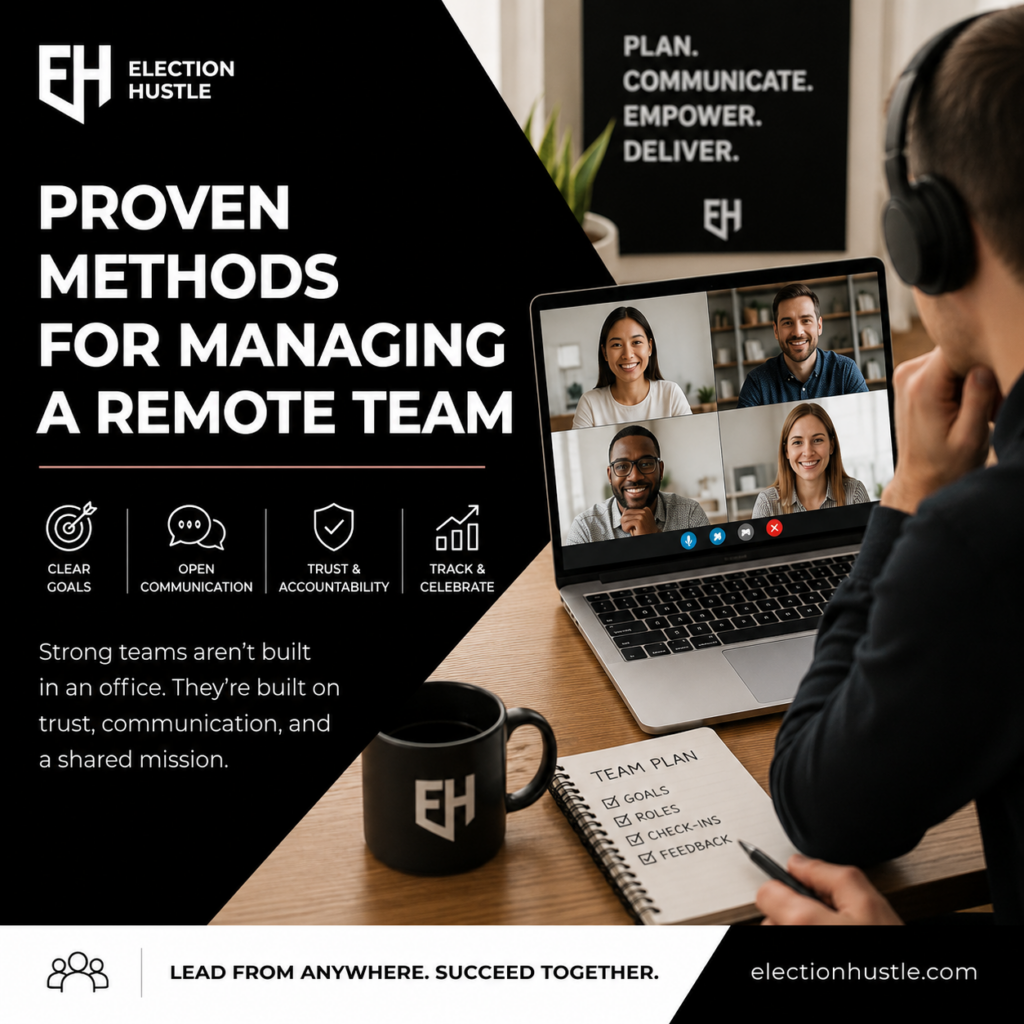
Proven Methods for Managing a Remote Team: How Election Hustle Turns Digital Collaboration Into Sustainable Community Impact
Introduction: Remote Work Is Not Just a Workplace Trend
Remote work is not only something that happens in corporate offices. It also happens in community organizing, campaign work, nonprofit outreach, social media management, digital fundraising, e-commerce operations, advocacy, event planning, and volunteer coordination.
For many organizations, remote work is not a luxury. It is the only way the work gets done.
A community page may have one person designing graphics from home, another person responding to messages after work, another person preparing event listings, and another person managing a storefront or donation campaign. A feminist collective may have writers, designers, advocates, moderators, organizers, and supporters spread across different cities, schedules, and responsibilities. A civic organization may depend on people who cannot all meet in one room but still need to move together.
That is why remote team management matters.
At Election Hustle, we believe digital collaboration should not feel scattered, confusing, or exhausting. Remote teams need more than a group chat. They need structure, shared language, clear expectations, useful tools, strong follow-up, and a culture that respects both the mission and the people doing the work.
This article explains proven methods for managing a remote team through the Election Hustle lens. It uses Chicago Southland Activities and Leaders and 3WF – Third Wave Feminism as case-study examples of how meaningful social media interaction can become organized labor, fundraising, e-commerce, awareness-building, and sustainable staff support.
Remote team management is not only about productivity. It is about protecting the work from chaos. It is about making sure people know what they are responsible for, how their work connects to the larger mission, and how the organization can continue serving the community without burning out the people behind the scenes.
A remote team can be powerful. But only if it is managed with intention.
The Election Hustle View: Digital Work Still Needs Discipline
Election Hustle helps organizations turn attention into action. That process depends on people. People write the posts. People design the graphics. People answer questions. People build storefronts. People follow up with donors. People create pitch decks. People track sponsorship leads. People manage events. People update websites. People solve problems when the technology does not cooperate.
When those people are remote, the work can easily become invisible.
Someone may spend hours responding to comments, but no one tracks the value of that work. Someone may create a product listing, but no one knows it is ready to promote. Someone may gather event details, but the graphic is never made. Someone may receive a sponsorship inquiry, but the follow-up gets lost in a message thread. Someone may notice a meaningful social media interaction, but the organization has no system to turn that interaction into a donation, sale, volunteer sign-up, or partnership.
Remote work fails when the team depends on memory instead of systems.
Election Hustle’s approach is simple: if the work matters, organize it.
That means every remote team needs a shared place for tasks, a shared rhythm for communication, a shared definition of success, and a shared understanding of how each role supports the mission.
For Chicago Southland Activities and Leaders, remote team management might involve coordinating event submissions, social media posts, local business features, sponsorship outreach, e-commerce updates, and community messages.
For 3WF – Third Wave Feminism, remote team management might involve coordinating advocacy content, educational resources, merchandise, fundraising campaigns, awareness posts, community moderation, and donor follow-up.
In both cases, the work is digital, but the impact is real.
The goal is not to make community work feel corporate. The goal is to give community work enough structure to survive.
Case Study One: Remote Team Management for Chicago Southland Activities and Leaders
Chicago Southland Activities and Leaders represents a community-based digital platform with strong potential for local impact. It connects people to activities, leaders, events, causes, and opportunities across the region. This kind of platform can become a powerful public resource, especially when residents are looking for things to do, people to support, and organizations to follow.
But a platform like this requires consistent behind-the-scenes labor.
Someone has to collect information.
Someone has to verify event details.
Someone has to design posts.
Someone has to write captions.
Someone has to schedule content.
Someone has to respond to messages.
Someone has to track which posts perform well.
Someone has to identify sponsorship opportunities.
Someone has to maintain the website or storefront.
Someone has to follow up with partners.
If all of that work is happening remotely, the team needs a system.
Election Hustle would approach this kind of remote team by organizing the work into clear lanes:
Content collection
Graphic design
Caption writing
Scheduling and publishing
Community engagement
Sponsor outreach
Storefront management
Analytics and reporting
Partner follow-up
Each lane needs an owner. That does not mean one person does everything. It means one person is responsible for making sure the work does not disappear.
For Chicago Southland Activities and Leaders, remote management should also connect daily tasks to revenue. If a post about a local event performs well, the team should know how to turn that engagement into a stronger partner relationship. If a business asks about promotion, the team should know where the sponsor deck is. If community members keep asking for certain types of activities, the team should track that demand. If a branded product gains interest, the team should connect it to the e-commerce storefront.
Remote management should help the team move from scattered attention to organized opportunity.
That is the Election Hustle difference.
The goal is not just to keep posting. The goal is to build a community platform that can support itself, its organizers, its contributors, and its staff.
Case Study Two: Remote Team Management for 3WF – Third Wave Feminism
3WF – Third Wave Feminism represents a values-driven, cause-based digital community. Its work may involve education, advocacy, storytelling, awareness, feminist analysis, community support, cultural commentary, and fundraising.
This kind of work can be emotionally meaningful, but it can also be demanding.
Cause-based remote teams face unique challenges. The subject matter may be personal. The audience may expect fast responses. The team may be working with limited resources. Volunteers may have different availability. Staff may be stretched across content, organizing, fundraising, and emotional labor. Online conversations may require care, moderation, and boundaries.
Without structure, a remote advocacy team can burn out quickly.
Election Hustle’s approach would begin by naming the work clearly. Advocacy is labor. Content is labor. Moderation is labor. Fundraising is labor. Community education is labor. Digital care is labor. If the work has value, the team needs tools that make the labor visible and sustainable.
For 3WF, remote team management might include:
A content calendar for awareness campaigns.
A review process for sensitive posts.
A shared folder for graphics, logos, and educational materials.
A moderation guide for comments and messages.
A fundraising tracker for donors and campaigns.
A storefront workflow for merchandise and digital products.
A weekly check-in for priorities and emotional capacity.
A clear process for approving public statements.
A system for documenting community needs and questions.
The goal is to protect both the mission and the people.
A feminist platform should not have to depend on unpaid chaos to survive. It should be able to build revenue, support staff, sell products, raise awareness, and sustain the labor behind the message.
Remote management helps make that possible.
Method One: Start With Mission Clarity
Remote teams need a shared mission because they do not always share a room.
When people work in different locations, the mission becomes the center of gravity. It reminds the team why the work matters and helps them make decisions when no one is standing over their shoulder.
A strong mission statement should be simple enough to repeat and practical enough to guide action.
For Election Hustle, the mission might be expressed this way:
“We help organizations turn meaningful digital interaction into organized action, fundraising, e-commerce, awareness, and sustainable community impact.”
For Chicago Southland Activities and Leaders:
“We connect the Chicago Southland to activities, leaders, events, and opportunities that strengthen community life.”
For 3WF:
“We turn feminist education, storytelling, and digital community into awareness, advocacy, resources, and sustainable support.”
Once the mission is clear, remote team members can ask better questions:
Does this task support the mission?
Does this post help people understand the work?
Does this campaign move supporters toward action?
Does this storefront item reflect our values?
Does this partnership strengthen the community?
Does this fundraising ask support the people doing the labor?
Mission clarity prevents remote work from becoming random work.
Method Two: Define Roles Before Assigning Tasks
Remote teams struggle when everyone is expected to do everything.
A person may think someone else is handling the website. Another person may assume the graphic designer is also writing captions. A volunteer may send event details but not know who approves the final post. A donor message may sit unanswered because no one owns the inbox.
That is why roles must be defined before tasks are assigned.
A remote team should know who owns:
Content planning
Writing
Design
Publishing
Engagement
Fundraising
E-commerce
Partnerships
Administration
Technology
Data and reporting
Decision-making
The role does not have to be fancy. It just has to be clear.
For a small team, one person may hold multiple roles. That is normal. The important thing is to make responsibilities visible.
A simple role statement might look like this:
“Greg owns the sponsor deck and partner follow-up.”
“Jenni owns brand review and final approval.”
“The content lead gathers weekly post ideas.”
“The design lead creates graphics by Wednesday.”
“The engagement lead responds to comments and flags opportunities.”
“The storefront lead updates products and checks orders.”
“The fundraising lead tracks donor asks and follow-up.”
Clarity reduces conflict. It also reduces guilt. People should not feel responsible for tasks they were never assigned.
Remote teams need ownership, not confusion.
Method Three: Build a Communication Rhythm
Remote teams do not need constant meetings. They need predictable communication.
A communication rhythm tells people when updates happen, where decisions are made, and how urgent issues should be handled.
Without rhythm, the team may overuse texts, underuse email, bury decisions in chats, miss deadlines, or hold meetings that do not move the work forward.
A strong remote communication rhythm might include:
A weekly planning meeting.
A short midweek check-in.
A shared task board.
A daily or every-other-day written update for active campaigns.
A monthly review of fundraising, engagement, and storefront performance.
A clear emergency channel for urgent issues.
For Election Hustle clients, the rhythm should match the intensity of the work. A major fundraising campaign may need more frequent check-ins. A slow content month may need less. A crisis response requires faster communication. A routine e-commerce update may only require weekly review.
The key is that people know what to expect.
For Chicago Southland Activities and Leaders, a weekly rhythm might include:
Monday: collect events and sponsor opportunities.
Tuesday: draft captions and confirm details.
Wednesday: design and schedule posts.
Thursday: review engagement and respond to messages.
Friday: promote weekend activities and storefront items.
Sunday: review performance and plan next week.
For 3WF, a weekly rhythm might include:
Monday: choose awareness themes.
Tuesday: draft educational content.
Wednesday: review sensitive language and design graphics.
Thursday: schedule posts and prepare fundraising messages.
Friday: engage community and promote merchandise.
Sunday: reflect on response, emotional workload, and next steps.
Rhythm creates momentum.
Method Four: Use the Right Tools, Not Too Many Tools
Remote teams often make one of two mistakes. They either use no tools at all, or they use too many tools.
No tools creates chaos. Too many tools creates confusion.
The best remote teams use a simple tool stack that everyone understands.
A basic remote team tool stack might include:
Google Drive or Microsoft OneDrive for shared files.
Google Docs or Microsoft Word for writing and approvals.
Google Sheets or Excel for tracking lists, budgets, and outreach.
Trello, Asana, Monday.com, ClickUp, or Notion for tasks.
Slack, Microsoft Teams, or a structured group chat for communication.
Canva for social media graphics and basic presentation design.
Google Slides or PowerPoint for pitch decks.
Shopify, Squarespace, Wix, WooCommerce, or another storefront tool for e-commerce.
Mailchimp, Constant Contact, HubSpot, or another email tool for supporter lists.
Meta Business Suite or another scheduler for social media publishing.
The best tool is the one the team will actually use.
Election Hustle often recommends starting simple. A small remote team can do a lot with Google Drive, Canva, a task board, a spreadsheet, and a weekly meeting. More advanced tools can be added later.
The tool stack should answer five questions:
Where do files live?
Where do tasks live?
Where do conversations happen?
Where are decisions documented?
Where do we track money, supporters, sponsors, and sales?
If the team cannot answer those five questions, the remote system needs work.
Method Five: Create a Single Source of Truth
A single source of truth is the place where the team can find the most current and accurate information.
Remote teams need this because information spreads quickly and gets outdated quickly.
A sponsor price may change. A product description may be revised. An event time may be corrected. A donation link may be updated. A logo may be replaced. A pitch deck may get a new version. A campaign message may be approved in one place but not another.
Without a single source of truth, people use old files and wrong information.
For Election Hustle, a single source of truth might be a shared folder or project dashboard with:
Current logo files
Brand colors and fonts
Approved language
Current pitch deck
Sponsor packages
Donation links
Storefront links
Campaign calendar
Contact list
Task board
Content archive
Analytics reports
Meeting notes
For Chicago Southland Activities and Leaders, this could include event submission forms, sponsor information, posting guidelines, community partner contacts, and storefront assets.
For 3WF, this could include approved messaging, educational sources, moderation guidelines, fundraising campaigns, product files, and community care boundaries.
The rule is simple: if people need it to do the work, they should know where to find it.
Method Six: Make Invisible Work Visible
Remote teams often undervalue invisible work.
Answering messages is work.
Cleaning up a spreadsheet is work.
Following up with a donor is work.
Checking links is work.
Writing captions is work.
Moderating comments is work.
Updating a storefront is work.
Creating a pitch outline is work.
Researching sponsors is work.
Testing a form is work.
If no one tracks this labor, people may assume nothing is happening. That creates resentment, burnout, and poor planning.
Election Hustle encourages remote teams to make invisible work visible through task boards, weekly reports, and simple status updates.
A useful status update can be short:
Completed: three sponsor follow-ups, two graphics, one storefront update.
In progress: pitch deck revision and weekend event post.
Blocked: waiting for final logo and product pricing.
Next: send donation email and schedule posts.
This kind of update helps everyone see progress. It also helps leaders support the team before problems become crises.
For community organizations, visibility is especially important because much of the labor happens outside normal business hours. People may be working after jobs, between family responsibilities, or during weekends. Making work visible helps protect capacity.
Method Seven: Set Clear Deadlines and Definitions of Done
A remote task needs two things: a deadline and a definition of done.
A vague task sounds like this:
“Work on the sponsor deck.”
A clear task sounds like this:
“Draft slides 1–5 of the sponsor deck by Wednesday at 5 PM, including the opening statement, problem, audience, proof, and sponsorship opportunity.”
A vague task creates stress. A clear task creates action.
The definition of done tells the person what finished means. Does the task need a rough draft, final design, approval, upload, publishing, or follow-up? Those are different levels of completion.
For example:
A graphic is not done until it is exported and placed in the scheduling folder.
A caption is not done until it is reviewed and approved.
A product is not done until the listing, photo, price, description, and link are live.
A sponsor lead is not done until the contact is logged and follow-up date is assigned.
A pitch deck is not done until it is reviewed, exported as a PDF, and ready to send.
Remote teams need this level of clarity because people cannot rely on hallway conversations or casual reminders.
Clarity is kindness.
Method Eight: Design Better Meetings
Remote teams do not need more meetings. They need better meetings.
A useful meeting should have a purpose, an agenda, decisions, and next steps. If a meeting does not produce clarity, it may not be necessary.
Election Hustle recommends four types of remote meetings:
Planning meetings
Used to decide priorities, assign tasks, and prepare campaigns.
Production meetings
Used to move specific work forward, such as a pitch deck, storefront launch, or fundraising campaign.
Review meetings
Used to look at performance, engagement, sales, donations, and lessons learned.
Care and capacity meetings
Used to check workload, morale, boundaries, and team sustainability.
Cause-based teams especially need care and capacity conversations. A remote team working on feminist advocacy, community issues, political content, or social justice campaigns may face emotional strain. Ignoring that strain does not make the team stronger. It makes burnout more likely.
A strong remote meeting should end with:
What did we decide?
Who owns each task?
When is it due?
Where will the work live?
What is blocked?
What is the next check-in?
Meetings should create movement.
Method Nine: Build Accountability Without Micromanagement
Remote accountability is not about watching people. It is about making commitments visible.
Micromanagement weakens trust. But no accountability weakens the work.
The balance is created through clear goals, visible tasks, regular updates, and honest follow-up.
A remote leader should not have to ask, “Did anyone do the thing?” The task board or update rhythm should already show what happened.
Accountability can be built through:
Weekly priorities
Assigned owners
Deadlines
Status updates
Shared dashboards
Review meetings
Clear escalation paths
Documented decisions
For Election Hustle, accountability is connected to impact. The goal is not to control people. The goal is to make sure the work reaches the community, raises money, supports staff, and builds trust.
For Chicago Southland Activities and Leaders, accountability might mean making sure event posts go out on time, sponsors receive promised visibility, and messages from community partners are answered.
For 3WF, accountability might mean making sure educational posts are reviewed carefully, fundraising links work, merchandise campaigns launch on time, and community responses are handled with care.
Accountability protects the mission.
Method Ten: Connect Remote Work to Revenue
A remote team becomes more sustainable when it understands how its work connects to money.
This does not mean every task should be reduced to profit. It means the team should understand how fundraising, e-commerce, sponsorships, and awareness keep the organization alive.
A graphic may help sell a shirt.
A caption may move someone to donate.
A comment response may build donor trust.
A pitch deck may secure a sponsor.
A product photo may increase storefront sales.
An event post may attract a partner.
A weekly report may help justify funding.
A testimonial may strengthen a grant application.
When remote team members understand this connection, their work feels more meaningful and strategic.
For Chicago Southland Activities and Leaders, a remote team should know how content supports sponsorship and local visibility. For 3WF, a remote team should know how education and advocacy can support donations, merchandise, and staff sustainability.
Election Hustle helps teams see the revenue pathway without losing the mission.
The question is not, “How do we monetize everything?”
The better question is, “How do we sustain the work so the people doing it can keep serving the community?”
Method Eleven: Protect Team Culture
Remote culture does not happen by accident.
A team culture is created by how people communicate, how decisions are made, how conflict is handled, how labor is recognized, and how success is celebrated.
A strong remote culture should include:
Respect for people’s time.
Clear communication.
No hidden expectations.
Recognition of completed work.
Room for feedback.
Healthy boundaries.
Shared commitment to the mission.
Honest conversations about capacity.
Celebration of wins.
For community and advocacy teams, culture matters because the work can be personal. People may care deeply about the cause. That passion can be powerful, but it can also make disagreement feel intense.
A healthy remote culture allows people to disagree without destroying trust.
Election Hustle encourages teams to create communication norms:
Assume good intent, but clarify quickly.
Do not bury urgent decisions in long message threads.
Use the task board for tasks, not memory.
Respect response-time boundaries.
Document decisions.
Bring conflict to the right space.
Celebrate progress before moving to the next demand.
A team that feels respected will do better work.
Method Twelve: Create Repeatable Workflows
Remote teams become stronger when they stop reinventing the same process every week.
A workflow is a repeatable sequence of steps.
For example, a social media workflow might look like this:
Collect ideas.
Draft captions.
Create graphics.
Review and approve.
Schedule posts.
Monitor engagement.
Capture meaningful interactions.
Follow up with leads.
Report results.
An e-commerce workflow might look like this:
Choose product idea.
Confirm design.
Create mockup.
Write description.
Set price.
Publish listing.
Promote product.
Track orders.
Report sales.
Adjust campaign.
A fundraising workflow might look like this:
Define campaign goal.
Write story.
Build donation page.
Create graphics.
Prepare email and social posts.
Launch campaign.
Thank donors.
Share progress.
Follow up.
Report impact.
A pitch deck workflow might look like this:
Define audience.
Write core story.
Gather proof.
Draft slides.
Design slides.
Review with team.
Revise.
Export PDF.
Send to prospects.
Track responses.
These workflows help remote teams move faster because the process is already known.
Election Hustle helps organizations build repeatable systems so they do not depend on emergency energy every time something needs to launch.
Method Thirteen: Measure What Matters
Remote teams need measurement, but not every number matters equally.
Likes matter less than action.
Views matter less than trust.
Comments matter less than conversion.
Followers matter less than community value.
The best metrics depend on the goal.
For awareness, track reach, shares, profile visits, website clicks, and message inquiries.
For fundraising, track donations, donor count, average gift, repeat donors, campaign conversion, and follow-up completion.
For e-commerce, track product views, sales, abandoned carts, revenue, best-selling items, and customer feedback.
For sponsorships, track leads, proposals sent, meetings booked, commitments, renewals, and sponsor satisfaction.
For remote team health, track workload, missed deadlines, unclear tasks, meeting effectiveness, and burnout risk.
For Chicago Southland Activities and Leaders, important metrics might include event reach, community submissions, sponsor inquiries, partner engagement, storefront sales, and audience growth.
For 3WF, important metrics might include campaign engagement, donor growth, merchandise sales, educational content saves, resource downloads, and community feedback.
Election Hustle believes data should help the team learn, not shame the team. Measurement should improve decisions.
Method Fourteen: Manage Conflict Early
Remote conflict often grows in silence.
A message sounds rude. A deadline is missed. A person feels ignored. A decision is made without the right input. Someone feels overworked. Someone else feels criticized. Because the team is remote, the tension may not surface until it becomes a larger problem.
Good remote leaders address conflict early.
That does not mean every disagreement needs a dramatic meeting. It means the team should have a healthy way to clarify confusion, repair communication, and reset expectations.
A simple conflict process might include:
Name the issue clearly.
Focus on the work and impact.
Ask what happened before assuming motive.
Clarify the expectation.
Agree on the next step.
Document the decision if needed.
Move forward without punishment or gossip.
For values-driven organizations like 3WF, conflict may also involve language, representation, safety, or emotional impact. Those conversations require care. A remote team should have a review process and a decision-maker for sensitive public content.
For community platforms like Chicago Southland Activities and Leaders, conflict may involve event accuracy, partner expectations, promotional fairness, or sponsor visibility. These issues also need clear processes.
Conflict is not failure. Unmanaged conflict is the danger.
Method Fifteen: Document Everything Important
Remote teams need documentation because people cannot depend on memory.
Documentation does not have to be complicated. It can be a shared document, a spreadsheet, a task card, or meeting notes.
Document:
Decisions
Deadlines
Approved language
Brand rules
Passwords and access processes
Sponsor packages
Donation links
Storefront instructions
Posting schedules
Campaign plans
Meeting notes
Follow-up commitments
Review steps
Crisis response procedures
Documentation helps new team members learn faster. It helps current team members avoid confusion. It protects the organization when someone leaves. It makes the work more professional.
For Election Hustle, documentation is part of sustainability. A community organization should not lose its systems every time a volunteer changes roles or a staff member gets busy.
If the knowledge matters, write it down.
Method Sixteen: Support the Humans Behind the Screens
Remote work can hide stress.
A team member may look available because they are online, but they may be overwhelmed. A volunteer may keep saying yes because they care, but they may be close to burnout. A founder may answer messages at midnight because no one else knows how. A designer may produce graphics every week without anyone realizing how much time it takes.
Remote leadership must pay attention to capacity.
That means asking:
Who has too much work?
Who needs support?
Who is doing invisible labor?
Who has not taken a break?
Who needs clearer expectations?
Who should be paid for work that has become essential?
What can be paused, delegated, automated, or simplified?
Election Hustle’s view is that sustainability is not only financial. It is human.
Organizations cannot build community impact by exhausting the people who care most.
For Chicago Southland Activities and Leaders, this may mean creating paid roles as sponsorships and storefront revenue grow. For 3WF, it may mean using fundraising to support content labor, moderation, education, and staff care.
Making a living from mission-driven work should not be treated as shameful. It should be planned.
Method Seventeen: Build a Remote Team Dashboard
A remote team dashboard gives everyone a quick view of what is happening.
It does not have to be fancy. It can be built in Notion, Trello, ClickUp, Asana, Monday.com, Google Sheets, or another tool. The purpose is to reduce confusion.
A useful dashboard might include:
This week’s priorities
Current campaigns
Task owners
Deadlines
Content calendar
Fundraising goal
Storefront updates
Sponsor leads
Important links
Recent wins
Blocked tasks
Next meeting
For Election Hustle clients, a dashboard helps connect strategy to action.
A Chicago Southland Activities and Leaders dashboard might show upcoming events, sponsor posts, local business features, weekend activity pushes, and storefront promotions.
A 3WF dashboard might show awareness themes, content drafts, fundraiser progress, merchandise launches, donor follow-up, and moderation notes.
The dashboard should be simple enough that people actually use it.
Method Eighteen: Turn Social Media Engagement Into Team Assignments
One of Election Hustle’s most important remote management practices is treating social media engagement as actionable information.
When someone comments, shares, asks a question, or expresses support, the team should know what to do next.
A meaningful comment might become a testimonial.
A question might become a resource post.
A sponsor inquiry might become a sales lead.
A product request might become a storefront idea.
A repeated concern might become an awareness campaign.
A supportive message might become a donor follow-up.
An event tag might become a partnership opportunity.
Remote teams should create a simple engagement workflow:
Capture the interaction.
Categorize it.
Assign a follow-up.
Respond appropriately.
Track the outcome.
Use the insight in future content.
For Chicago Southland Activities and Leaders, this could help identify what events, neighborhoods, businesses, and activities the community wants to see more often.
For 3WF, this could help identify what topics, resources, products, and campaigns the community needs.
Social media should not be treated as noise. It is community intelligence.
Method Nineteen: Create Boundaries Around Availability
Remote work can become endless if the team does not set boundaries.
A healthy remote team should know when people are expected to respond and when they are not. This is especially important for volunteer teams, advocacy teams, and small organizations where people may feel pressure to always be available.
Boundaries might include:
Standard response windows.
Urgent versus non-urgent channels.
No late-night non-emergency messages.
Office hours for review.
Clear handoff procedures.
Weekend coverage schedules.
Time off expectations.
Boundaries are not a lack of commitment. They are how commitment lasts.
For Election Hustle, the best remote systems respect the fact that people have lives, families, jobs, health needs, and limits. Strong systems make it possible for people to contribute without being consumed.
Method Twenty: Celebrate Wins and Share Impact
Remote teams need celebration because they do not always experience the energy of being together.
Celebrate when a campaign launches.
Celebrate when a sponsor says yes.
Celebrate when the storefront makes a sale.
Celebrate when a donor gives.
Celebrate when a post helps someone find an event.
Celebrate when a community member says the content helped them.
Celebrate when the team completes a difficult project.
Celebration is not fluff. It reinforces meaning.
A weekly win report can help:
“This week, we launched two product listings, reached new supporters, responded to sponsor inquiries, and turned community comments into three new content ideas.”
For Chicago Southland Activities and Leaders, wins may include local partners being seen, families finding activities, and sponsors supporting the platform.
For 3WF, wins may include people learning, sharing resources, buying merchandise, donating, or feeling less alone.
Election Hustle encourages organizations to share impact internally and externally. The team needs to know that the work is working. Supporters need to know their support matters.
A Practical Remote Team Operating System
Here is a simple operating system that Election Hustle could use with a remote community organization:
Mission
One sentence that explains why the work exists.
Roles
A clear list of who owns content, design, engagement, fundraising, storefront, partnerships, and operations.
Tools
One place for files, one place for tasks, one place for communication, one place for tracking money and leads.
Rhythm
Weekly planning, midweek check-in, monthly review.
Workflows
Repeatable steps for content, fundraising, e-commerce, sponsorship, and pitch decks.
Dashboard
A simple view of priorities, tasks, deadlines, links, and blockers.
Metrics
A small set of numbers tied to awareness, revenue, engagement, and team health.
Culture
Communication norms, boundaries, recognition, and care.
This operating system can support small teams, volunteer teams, growing nonprofits, civic groups, advocacy collectives, and community brands.
The system does not need to be perfect. It needs to be used.
Remote Team Management and the Pitch Deck Connection
Remote team management also improves the quality of a pitch deck.
A strong pitch deck requires coordinated work. Someone must gather proof. Someone must write the story. Someone must design slides. Someone must confirm numbers. Someone must define the ask. Someone must review the deck. Someone must send it and track follow-up.
Without remote coordination, pitch decks become rushed and unclear.
With a good remote system, the deck becomes a shared product of the team’s best thinking.
For Chicago Southland Activities and Leaders, the remote team can gather event examples, audience insights, partner testimonials, sponsor opportunities, and storefront ideas.
For 3WF, the remote team can gather advocacy examples, community feedback, educational themes, product ideas, donor needs, and impact stories.
Election Hustle helps teams organize those pieces into a clear pitch.
That is why remote management matters beyond internal operations. It directly affects fundraising, sales, partnership development, and public trust.
Sample Remote Weekly Workflow for Election Hustle Clients
Monday: Strategy and Priorities
Review mission, campaign goals, upcoming deadlines, and revenue opportunities. Assign weekly owners.
Tuesday: Content and Outreach
Draft captions, collect stories, prepare graphics, update sponsor leads, and review engagement.
Wednesday: Production
Finalize designs, update storefront products, prepare donation or sponsorship materials, and schedule content.
Thursday: Follow-Up
Respond to community messages, send partner emails, follow up with sponsors, review donor activity, and test links.
Friday: Promotion
Promote weekend content, storefront items, events, campaigns, and calls to action.
Sunday: Review and Reset
Review performance, celebrate wins, identify blockers, and prepare next week’s priorities.
This rhythm can be adjusted, but it gives remote teams a predictable structure.
The Leadership Mindset Remote Teams Need
Managing a remote team requires a different kind of leadership.
A remote leader must be clear without being controlling. Encouraging without being vague. Strategic without being detached. Flexible without being disorganized. Mission-driven without ignoring money. People-centered without avoiding accountability.
The strongest remote leaders ask:
What does the team need to know?
What needs to be decided?
What needs to be documented?
Who owns the next step?
What support is missing?
What work is invisible?
What opportunity are we not following up on?
How does this connect to impact and revenue?
This mindset is especially important for Election Hustle’s work because digital organizing sits at the intersection of people, technology, money, and mission.
A remote team is not managed well just because people are busy. It is managed well when people are aligned.
Conclusion: Remote Teams Can Build Real-World Power
Chicago Southland Activities and Leaders and 3WF – Third Wave Feminism show why remote team management matters.
One example centers local activities, leaders, events, and community connection. The other centers feminist education, advocacy, awareness, and movement-building. Both depend on digital interaction. Both require people working behind the scenes. Both need tools, clarity, fundraising, e-commerce, and sustainable systems. Both can use remote team management to turn online engagement into organized impact.
Election Hustle believes the future belongs to organized communities.
A remote team can raise money.
A remote team can sell products.
A remote team can build awareness.
A remote team can support staff.
A remote team can create pitch decks.
A remote team can manage campaigns.
A remote team can serve local communities and social causes with discipline, creativity, and care.
But it does not happen by accident.
It happens when the mission is clear, roles are defined, tools are simple, communication is consistent, tasks are visible, deadlines are real, culture is protected, and meaningful interactions are treated as opportunities for action.
Remote work is not lesser work. Digital labor is not imaginary labor. Community management is not casual labor. Advocacy is not free labor. Organizing is not random labor.
The work has value.
Election Hustle helps communities organize that value.
We help teams move from scattered messages to shared systems, from online engagement to revenue, from remote effort to measurable impact, and from meaningful interaction to sustainable community power.
That is the Election Hustle way.