Digital marketing does not happen without creative content.
A campaign can have a strong message, a good offer, a clear audience, and a smart outreach plan, but it still needs visuals that help people stop, understand, remember, and act.
That is where artboards come in.
An artboard is a designed creative asset or layout that can be used across digital platforms. It may become a social media post, ad graphic, email header, story slide, website banner, fundraising visual, event announcement, product promotion, sponsor graphic, or campaign message.
For Election Hustle, creative content is not just decoration. It is part of the organizing system. A good graphic can explain the message faster. A strong campaign visual can help build trust. A clear call-to-action design can move someone from scrolling to clicking, donating, buying, signing up, or sharing.
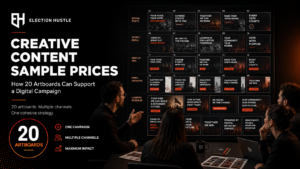
This sample strategy shows how an investment of $1,500 in 20 artboards could support a digital campaign with an estimated 4,000 views, creating an estimated return of about $0.38 per view.
This is only a sample. Actual results may vary depending on audience, platform, message quality, timing, creative direction, targeting, placement, and campaign goals.
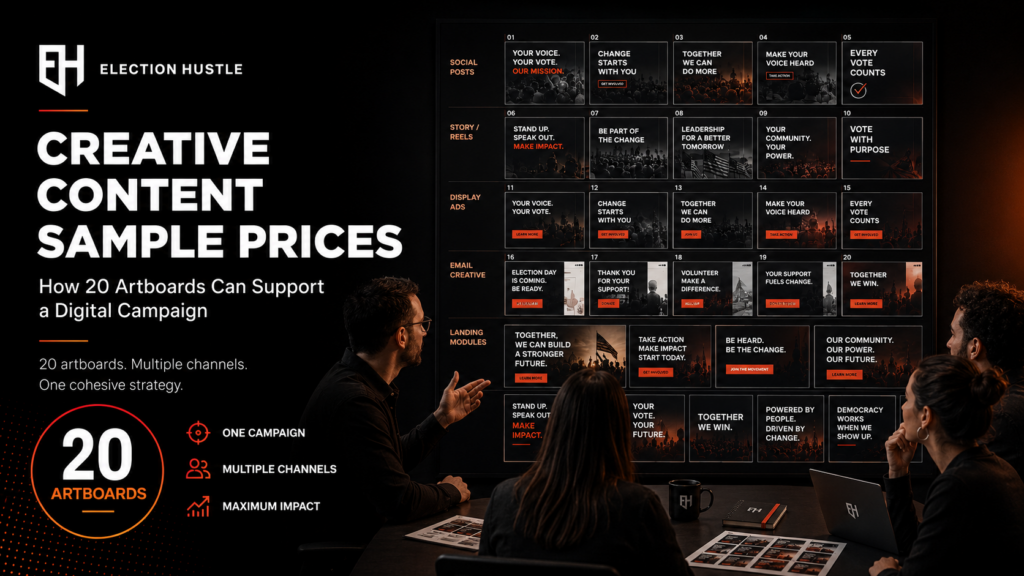
Sample Creative Strategy Mockup
Investment: $1,500
Artboards: 20
Estimated Reach/Engagement: 4,000 views
Estimated Cost Per View: About $0.38 per view
This sample shows how creative production can support campaign visibility across multiple touchpoints. With 20 artboards, an organization can build a small but useful campaign package that gives the team enough visual variety to test messages, promote different actions, and keep the campaign from feeling repetitive.
The cost per view is calculated by dividing the total investment by the estimated views.
$1,500 divided by 4,000 views equals about $0.375 per view, or roughly $0.38 per view.
That number is useful for planning, but it should not be the only measure of success. A view is not the same as a click, donation, purchase, lead, volunteer sign-up, or sponsor inquiry. The real goal is not simply to be seen. The real goal is to help people take action.
What Can 20 Artboards Include?
A set of 20 artboards can be used in many ways depending on the campaign.
For a political campaign, the artboards might include voter education graphics, candidate introductions, issue statements, Get Out The Vote reminders, donation asks, volunteer recruitment posts, endorsement graphics, event promotions, and quote cards.
For a community platform like Chicago Southland Activities and Leaders, 20 artboards might include weekend activity guides, local business spotlights, sponsor graphics, event announcements, regional pride posts, community leader features, storefront promotions, and callouts encouraging people to submit events.
For 3WF – Third Wave Feminism, 20 artboards might include advocacy explainers, feminist education slides, donor campaign graphics, merchandise promotions, virtual event announcements, quote cards, awareness campaign visuals, and community action prompts.
For Election Hustle, 20 artboards might include blog graphics, service explainers, case study graphics, digital marketing tips, field outreach samples, e-commerce promotions, business planning visuals, and calls to request a consultation.
The strength of 20 artboards is that they allow a campaign to tell a larger story over time.
One graphic may introduce the campaign.
Another may explain the problem.
Another may show the solution.
Another may promote the offer.
Another may provide proof.
Another may ask people to act.
Another may thank supporters.
Another may remind people before the deadline.
That is how creative content becomes a campaign sequence.
Why Creative Variety Matters
Many campaigns make the mistake of relying on one graphic too heavily.
They create one flyer, one post, or one announcement and use it everywhere. That may work for a small update, but larger campaigns need variety.
People need repetition, but not boredom.
Creative variety helps a campaign repeat the same core message in different ways. This keeps the message visible without making the audience feel like they are seeing the exact same post every time.
A campaign might test:
Different headlines.
Different calls to action.
Different colors or layouts.
Different audience segments.
Different issue angles.
Different product images.
Different sponsor placements.
Different formats for feed, story, email, and ads.
For Chicago Southland Activities and Leaders, one artboard might appeal to families looking for weekend activities, while another might appeal to local businesses interested in sponsorship. Both support the same platform, but they speak to different audiences.
For 3WF, one artboard might educate supporters about a feminist issue, while another asks donors to fund the labor behind advocacy work. Both support the same mission, but they serve different stages of the supporter journey.
Election Hustle uses creative variety to move people from awareness to action.
Cost Per View Is Useful, But It Is Not the Whole Story
The sample mockup estimates a return of about $0.38 per view.
That can help organizations understand the relationship between creative investment and audience reach. However, cost per view is only one part of campaign evaluation.
A campaign should also ask:
Did people click?
Did people donate?
Did people buy?
Did people sign up?
Did people share?
Did people comment meaningfully?
Did sponsors notice value?
Did the campaign grow the email list?
Did the graphics help explain the message?
Did the creative assets continue to be useful after the campaign?
A graphic that gets fewer views but produces donations may be more valuable than a graphic that gets many views but no action.
A sponsor graphic that helps close a partnership may be worth more than its view count suggests.
A fundraising visual that clearly explains the need may continue to work across email, social media, and pitch decks.
A strong artboard can have value beyond one post.
How Artboards Support Digital Marketing
Artboards can support several parts of a digital campaign.
They can be used for organic social media, paid ads, email graphics, website banners, blog feature images, landing pages, product launches, sponsor packages, pitch decks, donation campaigns, event promotions, and digital toolkits.
For Election Hustle, artboards help connect the message across platforms.
If someone sees a social media post, then an email, then a website page, then an ad, the campaign should feel consistent. The visuals should make the organization recognizable. The language should reinforce the same message. The call to action should be clear.
This consistency builds trust.
A campaign with inconsistent visuals can feel disorganized. A campaign with strong creative direction feels more professional, even when the team is small.
How Artboards Support Fundraising
Fundraising depends on clarity and trust.
People are more likely to give when they understand the need, believe the organization is credible, and see a clear way to help.
Artboards can help explain:
What the campaign is raising money for.
How much is needed.
What the money supports.
Who benefits.
What progress has been made.
How people can donate.
Why the campaign matters now.
For 3WF – Third Wave Feminism, fundraising artboards could show how donations support feminist education, digital advocacy, content creation, moderation, merchandise campaigns, community resources, and staff sustainability.
For Chicago Southland Activities and Leaders, fundraising or sponsorship artboards could show how support helps maintain community visibility, promote local events, highlight leaders, and build digital infrastructure.
For Election Hustle, fundraising-style creative can help clients explain the connection between digital engagement and real-world support.
Good fundraising graphics make the ask easier to understand.
How Artboards Support E-Commerce
E-commerce needs strong visuals.
People often decide whether to click, browse, or buy based on the first image they see. Product artboards can help show the item, explain its meaning, and connect the purchase to a larger mission.
For Chicago Southland Activities and Leaders, artboards might promote regional merchandise, community pride products, event guides, or sponsor-supported items.
For 3WF, artboards might promote feminist shirts, stickers, posters, tote bags, digital guides, campaign products, or limited-edition merchandise connected to advocacy themes.
E-commerce artboards should answer:
What is the product?
Who is it for?
What does it represent?
How much does it cost?
Where can people buy it?
How does the purchase support the mission?
A product graphic should not only look good. It should help people decide.
How Artboards Support Sponsorships
Sponsors want visibility.
If an organization is offering sponsorship packages, it needs creative assets that show sponsor value clearly and professionally.
Artboards can support sponsorships by creating:
Sponsor announcement graphics.
Featured partner posts.
Event sponsor slides.
Community guide sponsor placements.
Thank-you graphics.
Paid promotion examples.
Sponsor deck visuals.
Campaign recap graphics.
For Chicago Southland Activities and Leaders, sponsor artboards could show local businesses how they will appear to the community. A sponsor may be more likely to say yes when they can see what the visibility looks like.
For 3WF, sponsor or partner artboards must be mission-aligned. The creative should make the partnership feel authentic, not forced.
For Election Hustle, sponsor-related creative helps turn community attention into organized revenue.
How to Plan 20 Artboards
A smart 20-artboard package should be planned before design begins.
One possible structure could be:
4 awareness graphics
4 education or explanation graphics
4 call-to-action graphics
3 proof or testimonial graphics
3 product, donation, or sponsor graphics
2 reminder or deadline graphics
Another structure could be:
5 social feed posts
5 story graphics
3 email graphics
3 ad variations
2 website graphics
2 sponsor or partner graphics
The best structure depends on the campaign goal.
Before creating artboards, ask:
What is the campaign trying to accomplish?
Who is the audience?
What message needs to be repeated?
What actions do we want people to take?
Where will the artboards be used?
What sizes are needed?
What copy should appear on each graphic?
What brand assets are required?
What deadline matters?
How will success be measured?
The clearer the plan, the stronger the creative package.
What Campaigns Should Budget Beyond Artboards
The sample investment is $1,500 for 20 artboards, but organizations should remember that design is only one part of a campaign.
Additional needs may include:
Copywriting
Strategy
Brand direction
Ad placement
Landing page setup
Email formatting
Social media scheduling
Reporting
Video editing
Printing
QR code setup
Photography
Product mockups
Compliance review
Campaign management
A set of artboards can be powerful, but the organization still needs a plan for using them.
A graphic that is never posted, never boosted, never emailed, and never connected to a call to action will not create much impact.
Election Hustle encourages organizations to think about creative assets as part of a larger campaign system.
Questions to Ask Before Buying Artboards
Before investing in artboards, ask:
How many designs are included?
Are different sizes included?
Are revisions included?
Is copywriting included?
Are source files included?
Are social media captions included?
Are the artboards designed for ads, organic posts, email, or website use?
Are brand colors and fonts included?
Will the designer create templates for future use?
Is campaign strategy included?
How will success be measured?
Can these assets be reused later?
These questions help prevent confusion.
A campaign may think it is buying a full strategy when it is only buying graphics. Another campaign may think it is buying static posts when it also needs ad variations, story formats, or email headers.
Clarity saves money.
What Happens Without Strong Creative?
Without strong creative, a campaign can lose attention quickly.
People may scroll past the message.
The brand may feel inconsistent.
The call to action may be unclear.
Sponsors may not see value.
Donors may not understand the need.
Customers may not trust the storefront.
Supporters may not know what to share.
The campaign may look less organized than it actually is.
Good creative helps people understand faster.
It does not replace strategy, but it makes strategy visible.
The Election Hustle Creative Formula
Election Hustle’s creative formula is:
Message. Audience. Format. Action. Measurement.
Message: What are we trying to say?
Audience: Who needs to see it?
Format: Where will the design appear?
Action: What should people do next?
Measurement: How will we know whether it worked?
This formula keeps artboards connected to outcomes.
A beautiful design is not enough.
A clear design that moves people is better.
Conclusion: Artboards Turn Strategy Into Something People Can See
Creative content is one of the most important parts of digital marketing because it gives the campaign a visible form.
A $1,500 investment in 20 artboards can help a campaign create a consistent visual presence across social media, ads, email, websites, storefronts, sponsor materials, and fundraising campaigns. With an estimated 4,000 views, the sample return is about $0.38 per view.
But the real value of artboards is not only in the view count.
The real value is in what the creative helps people understand and do.
For Chicago Southland Activities and Leaders, artboards can help promote events, sponsors, community guides, local businesses, and regional pride.
For 3WF – Third Wave Feminism, artboards can help explain advocacy, promote merchandise, support fundraising, educate the audience, and build campaign identity.
For Election Hustle, artboards help turn ideas into visible systems that support action.
Digital marketing needs creative assets that are clear, consistent, and connected to a goal. When used well, artboards can help move people from awareness to engagement, from engagement to trust, and from trust to action.
That is the Election Hustle way.
We do not design just to decorate.
We design to organize attention into impact.