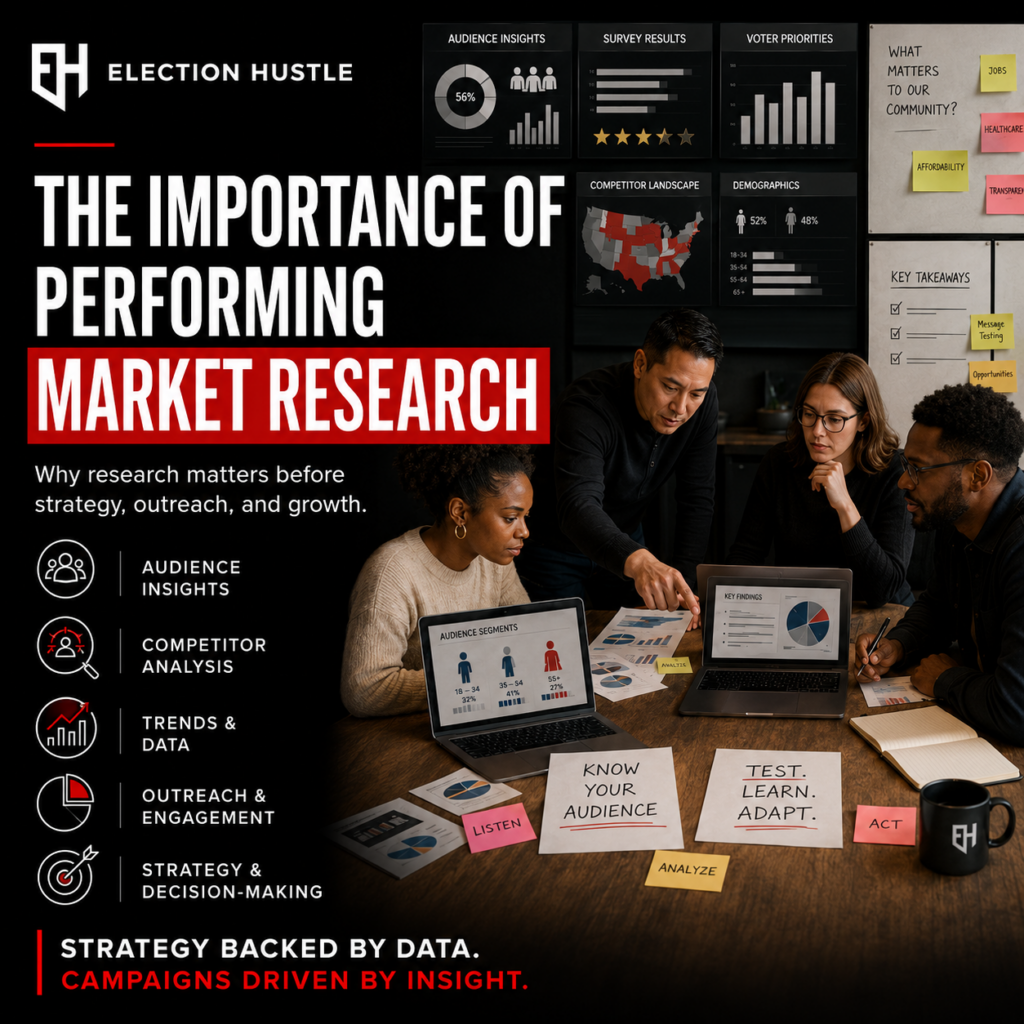
Introduction: Guessing Is Not a Strategy
In 2026, organizations cannot afford to build campaigns, storefronts, social media strategies, donor programs, or community platforms based only on guesses.
The digital world moves too fast. Audiences change quickly. Social media platforms shift. Search behavior changes. Customers compare more options. Donors expect clearer impact. Sponsors want proof. Remote teams need shared information. Machine learning tools can process more data than a person can read manually, but they still need human judgment to make the insight useful.
That is why market research matters.
Market research is the process of learning about your audience, your competitors, your community, your customers, your donors, your sponsors, your trends, and your opportunities before making major decisions. It helps you understand what people need, what they value, what they are already doing, what problems they face, what messages they respond to, and what would make them take action.
At Election Hustle, we believe meaningful interaction should lead somewhere. A comment should not just sit in a thread. A share should not disappear into the feed. A donor question should not go unanswered. A product idea should not be launched blindly. A sponsor pitch should not be built without knowing what sponsors need. A community page should not post randomly and hope for the best.
Market research gives direction to the hustle.
It helps organizations turn attention into action, action into resources, and resources into sustainable impact. It helps remote teams work from the same facts. It helps leaders make decisions with evidence instead of instinct alone. It helps machine learning tools become useful assistants rather than mysterious shortcuts.
This article explains why market research is important in 2026, especially for remote teams using machine learning tools. It also uses Election Hustle’s case-study examples — Chicago Southland Activities and Leaders and 3WF – Third Wave Feminism — to show how market research can support fundraising, e-commerce, awareness-building, organizing tools, staff sustainability, and community impact.
What Market Research Means in Plain Language
Market research sounds formal, but the basic idea is simple.
Market research means learning before acting.
Instead of asking, “What do we feel like posting?” ask, “What does our audience need to hear?”
Instead of asking, “What product should we sell?” ask, “What would our supporters actually buy and why?”
Instead of asking, “Who might sponsor us?” ask, “Which sponsors need access to our audience and what value can we prove?”
Instead of asking, “Why are donations slow?” ask, “Do people understand the cause, the need, and the impact of giving?”
Instead of asking, “Why is the team confused?” ask, “Do we have shared research, shared goals, and shared language?”
Market research can include surveys, interviews, social media analysis, website analytics, sales data, donor feedback, competitor reviews, keyword research, community conversations, trend tracking, customer service questions, event attendance, email performance, and product testing.
It can be simple or advanced.
A small community group might start by reviewing which posts received the most questions.
A growing e-commerce project might compare product sales by design, price, and message.
A nonprofit might interview donors about why they give.
A feminist advocacy platform might track which educational topics generate meaningful engagement.
A local activity page might study which types of events families ask for most often.
A digital organizing brand like Election Hustle might study which services clients need before they even know how to ask for them.
The point is not to collect data for decoration. The point is to learn what should happen next.
Why Market Research Matters More in 2026
In 2026, organizations face more noise than ever.
People are overwhelmed by content. Businesses compete for attention across many platforms. Community members see posts, videos, ads, emails, notifications, and recommendations all day long. Donors are asked to support many causes. Customers compare products quickly. Sponsors want measurable value. Staff members are often remote, hybrid, part-time, freelance, or volunteer-based.
This environment rewards organizations that understand their audience.
Market research helps answer questions such as:
Who are we really serving?
What do they care about right now?
What problems are they trying to solve?
What messages feel trustworthy?
What products or services are they willing to pay for?
What causes motivate them to donate?
What objections stop them from acting?
What channels do they use most?
What content do they share?
What proof do sponsors need?
What does our team need to know before launching a campaign?
Without research, an organization may confuse activity with progress.
It may post often but not grow support.
It may launch products people do not buy.
It may build a pitch deck that sponsors ignore.
It may create a donation campaign that fails to explain impact.
It may spend money on ads without knowing the audience.
It may recruit remote team members without giving them enough context.
It may use AI tools to generate content that sounds polished but misses the community’s real needs.
In 2026, the organizations that win trust will not simply be the loudest. They will be the ones that listen, learn, organize, and respond.
The Election Hustle View: Research Turns Interaction Into Intelligence
Election Hustle sees market research as a way to convert everyday interaction into useful intelligence.
A social media comment is not just a comment. It may reveal a need.
A repeated question is not just a question. It may reveal a content gap.
A low-selling product is not just a disappointment. It may reveal a pricing, design, or messaging issue.
A successful post is not just a win. It may reveal what people value.
A sponsor inquiry is not just a lead. It may reveal a revenue path.
A donor hesitation is not just resistance. It may reveal unclear impact language.
A remote team mistake is not just a performance issue. It may reveal missing research or unclear process.
This is why Election Hustle connects research to organizing.
Research is not only for reports. Research should help teams decide what to build, what to say, who to serve, what to offer, how to raise money, how to design products, how to pitch sponsors, and how to support staff.
For Election Hustle, market research is part of the path from attention to infrastructure.
Attention tells us people are watching.
Research tells us what their attention means.
Strategy tells us what to do with that meaning.
Tools help the team act on the strategy.
Revenue helps the work continue.
Impact proves the work matters.
That is the Election Hustle way.
Case Study One: Chicago Southland Activities and Leaders
Chicago Southland Activities and Leaders is a strong example of why market research matters for a community platform.
A page or platform focused on local activities, events, leaders, businesses, and community opportunities may already have meaningful engagement. People may comment on events, tag friends, ask questions, recommend activities, share posts, or request more information.
That interaction is valuable.
But without research, the team may not know what the interaction is saying.
Market research can help Chicago Southland Activities and Leaders answer:
Which types of activities get the most engagement?
Are families looking for free events, youth activities, nightlife, senior activities, civic events, small business markets, or arts programming?
Which local organizations repeatedly submit events?
Which businesses could benefit from sponsorship opportunities?
Which posts generate comments versus actual attendance?
Which neighborhoods or communities are underserved in the content?
What information do people need before attending an event?
What kind of weekend guide would people save or share?
What merchandise would supporters buy?
What sponsor packages would local businesses understand?
What price points are realistic for paid promotion?
This research can shape the entire business model.
If families respond most to weekend activity guides, the platform can create a weekly guide sponsored by local businesses.
If local businesses ask for visibility, the platform can build a sponsor deck.
If people ask about recurring event types, the team can create content categories.
If community members want to represent regional pride, the platform can test branded merchandise.
If organizers submit events inconsistently, the platform can create a better event submission form.
Market research helps the page become more than a posting space. It helps it become a community intelligence platform.
For Chicago Southland Activities and Leaders, research can turn local attention into sponsor value, storefront ideas, content strategy, event partnerships, and staff support.
Case Study Two: 3WF – Third Wave Feminism
3WF – Third Wave Feminism shows how market research matters for a cause-based digital community.
A feminist advocacy and education platform may receive strong emotional and intellectual engagement. People may respond to posts about equity, safety, labor, identity, history, culture, representation, policy, economic survival, or community care. Supporters may share personal stories, ask questions, buy merchandise, attend virtual events, or donate to campaigns.
But cause-based engagement needs careful interpretation.
Market research can help 3WF answer:
Which feminist topics are most urgent to the community right now?
What kinds of educational resources do people need?
Which posts create meaningful conversation instead of empty engagement?
What language feels accessible to new supporters?
What language feels too academic, too vague, or too polarizing?
What merchandise would supporters proudly wear or share?
What donor messages make the need for staff support clear?
What types of campaigns lead people to donate?
What concerns do supporters have before giving?
Which partners would align with the mission?
How can the organization protect community care while growing revenue?
This research is especially important because advocacy work can be misunderstood or underfunded.
People may support the message but not understand the labor behind it. They may share posts but not realize that content creation, moderation, design, research, fundraising, and event planning require time and money. Market research helps 3WF understand how to explain that labor in a way that supporters can act on.
For example, if supporters respond strongly to posts about unpaid labor, 3WF can connect that theme to a fundraising campaign about sustaining feminist work. If people save educational posts, 3WF can develop digital guides or workshops. If supporters ask where to buy merchandise, the team can test e-commerce products tied to specific campaigns. If donors want transparency, the team can create impact reports.
Market research helps 3WF turn awareness into resources without losing the values behind the work.
Remote Teams Need Shared Research
Remote teams can move fast, but they can also become misaligned.
When people are working from different places, different schedules, and different tools, they may not share the same understanding of the audience. One person may be designing graphics based on what they think looks good. Another may be writing captions based on old assumptions. Another may be building a storefront without knowing what supporters want. Another may be pitching sponsors without knowing which metrics matter. Another may be answering messages without tracking repeated questions.
This creates confusion.
Remote teams need shared research because they do not have the benefit of casual office conversations. They need a shared source of truth.
A remote market research system can include:
A shared folder for reports and notes.
A dashboard of audience insights.
A spreadsheet of repeated questions.
A content performance tracker.
A donor or sponsor feedback log.
A product idea tracker.
A competitor research file.
A monthly research review meeting.
A clear process for turning insights into tasks.
For Chicago Southland Activities and Leaders, a remote team may need one shared place to track event categories, sponsor leads, community questions, post performance, and storefront ideas.
For 3WF, a remote team may need one shared place to track campaign themes, donor feedback, merchandise interest, sensitive topic guidance, and community questions.
For Election Hustle, a remote team may need one shared place to track client needs, service demand, blog performance, social engagement, product ideas, and lead sources.
Research prevents remote teams from working from separate assumptions.
It gives everyone the same map.
New Digital Tools Can Help, But They Do Not Replace Judgment
Machine learning tools can help organizations process information faster.
They can identify patterns in data.
They can group customer comments by topic.
They can summarize survey responses.
They can help analyze social media trends.
They can recommend audience segments.
They can identify keywords.
They can predict which products may perform better.
They can help generate draft reports.
They can compare competitors.
They can support sentiment analysis.
They can help remote teams organize large amounts of information.
But machine learning tools are not magic.
They can be wrong.
They can misunderstand context.
They can reflect bias in the data.
They can overstate confidence.
They can miss local nuance.
They can generate summaries that sound accurate but need verification.
They can encourage teams to move faster than they understand.
Election Hustle’s rule is simple:
Use machine learning to assist research, not replace responsibility.
Human beings still need to define the question, check the sources, understand the community, interpret the results, and decide what action is ethical and useful.
For Chicago Southland Activities and Leaders, a machine learning tool might help summarize hundreds of comments about local events. But a human still needs to understand local geography, community relationships, and sponsor sensitivity.
For 3WF, a machine learning tool might help identify common themes in community responses. But a human still needs to understand feminist language, trauma-informed communication, cultural context, and the responsibility of advocacy work.
Machine learning can help teams listen at scale. It should not replace listening with care.
What Kind of Market Research Should Beginners Start With?
A beginner does not need a major research department.
Start simple.
The first level of market research should answer basic questions:
Who is interacting with us?
What are they asking for?
What content gets meaningful response?
What products or services are people interested in?
What problem are we solving?
Who else is serving this audience?
What do people pay for?
What do people donate to?
What would sponsors value?
What information are we missing?
A beginner-friendly research process might include:
Review the last 30 social media posts.
Write down the top comments and questions.
Identify the five posts with the strongest meaningful engagement.
Review website visits and popular pages if available.
Ask the audience one or two survey questions.
Interview five supporters, donors, customers, or partners.
Compare three similar organizations.
List the top five opportunities you discovered.
Choose one action based on the research.
That is enough to begin.
Market research does not have to be complicated to be useful.
Step One: Define the Research Question
Good research begins with a clear question.
Do not ask, “What does everyone think?”
Ask a specific question.
For Chicago Southland Activities and Leaders:
“What types of local activities do our followers want most during summer weekends?”
“What sponsorship benefits would local businesses pay for?”
“What information do families need before deciding to attend an event?”
“What kind of regional merchandise would supporters buy?”
For 3WF:
“What feminist education topics are most important to our community in 2026?”
“What prevents supporters from donating?”
“What kind of merchandise would feel meaningful rather than performative?”
“What campaign themes lead people to share and take action?”
For Election Hustle:
“What services do community organizations need most when trying to turn engagement into revenue?”
“What keeps clients from building a business plan, pitch deck, or storefront?”
“What blog topics help readers understand digital organizing?”
“What tools do remote teams need to work more effectively?”
A clear question keeps the research focused.
Without a clear question, teams collect information but do not know what to do with it.
Step Two: Identify the Audience Segment
Not every audience member is the same.
A sponsor is not the same as a donor.
A donor is not the same as a customer.
A customer is not the same as a volunteer.
A volunteer is not the same as a casual follower.
A casual follower is not the same as a staff member.
Market research should identify which audience segment matters for the question.
For Chicago Southland Activities and Leaders, audience segments may include families, event organizers, small businesses, local sponsors, community leaders, and residents looking for activities.
For 3WF, audience segments may include donors, advocates, educators, students, merchandise buyers, volunteers, and people seeking feminist resources.
For Election Hustle, audience segments may include community groups, nonprofits, campaigns, advocacy platforms, small businesses, remote teams, and cause-based brands.
Once the segment is clear, the research becomes more useful.
For example, if the goal is sponsorship revenue, do not only survey general followers. Talk to local business owners. If the goal is merchandise sales, talk to people who have bought or said they would buy. If the goal is donor growth, talk to supporters who care about the mission but have not donated yet.
Research should match the decision.
Step Three: Use Social Media as a Research Tool
Social media is not only a broadcasting tool. It is a research tool.
Every post gives feedback.
Look at:
Comments
Shares
Saves
Direct messages
Questions
Poll responses
Click-throughs
Video completion
Link clicks
Profile visits
Follower growth
Negative feedback
Repeated requests
Tags and mentions
But do not look only at vanity metrics.
A post with many likes may not create action. A post with fewer likes may generate donations, sales, messages, or sponsor interest.
Election Hustle recommends tracking meaningful engagement.
Meaningful engagement includes:
Someone asks how to help.
Someone asks where to donate.
Someone requests a product.
Someone tags a decision-maker.
Someone shares a personal story.
Someone asks for event details.
Someone wants to sponsor.
Someone joins a list.
Someone visits the website.
Someone buys.
Someone volunteers.
Someone requests a meeting.
For Chicago Southland Activities and Leaders, meaningful engagement may include event questions, business inquiries, sponsor interest, family activity requests, and community recommendations.
For 3WF, meaningful engagement may include donor questions, topic requests, resource needs, merchandise interest, and community members asking how to support the work.
Social media research helps teams understand what people are ready to do.
Step Four: Listen to Repeated Questions
Repeated questions are hidden research gold.
When multiple people ask the same question, the market is telling you something.
If people keep asking, “Where is this event?” the content needs better location details.
If people ask, “How do I donate?” the donation pathway is not clear enough.
If people ask, “Do you have shirts?” the storefront may be worth building.
If people ask, “Can my business sponsor this?” the sponsor package needs to exist.
If people ask, “What does this organization actually do?” the mission language needs work.
If people ask, “Is this virtual?” the event format needs to be clearer.
If people ask, “Where does the money go?” the impact story needs to be stronger.
Remote teams should track repeated questions in a shared file.
A simple tracker can include:
Date
Platform
Question
Category
Suggested action
Owner
Status
This turns audience confusion into operational improvement.
Step Five: Use Surveys Carefully
Surveys can be useful, but they must be short and clear.
Many organizations create surveys that are too long. People abandon them. The team collects incomplete results. Then no one uses the data.
A good beginner survey should ask only what you truly need.
For Chicago Southland Activities and Leaders, a short survey might ask:
What types of activities do you want to see more often?
Which days do you usually look for events?
Would you subscribe to a weekly activity guide?
Are you a resident, business owner, organizer, or sponsor?
What local information is hardest to find?
For 3WF, a short survey might ask:
Which feminist topics do you want us to cover more?
What kind of resources would help you take action?
Would you support the work through donations, merchandise, memberships, or events?
What would make you trust a fundraising campaign?
What kind of virtual event would you attend?
For Election Hustle, a short survey might ask:
What is your biggest challenge with digital organizing?
Do you need help with business planning, pitch decks, storefronts, fundraising, or social media?
What tools does your remote team use now?
What is stopping you from raising more money online?
What kind of guide would help your organization most?
Surveys should lead to decisions.
If the survey will not change what you do, do not ask it.
Step Six: Interview Real People
Interviews provide depth that surveys often miss.
A conversation can reveal motivations, fears, confusion, and opportunities that multiple-choice answers cannot capture.
Interview questions should be open-ended.
For supporters:
What made you follow this page?
What kind of content do you find most useful?
What would make you take action?
What feels unclear about our work?
What would make you donate, buy, sponsor, or share?
For sponsors:
Who are you trying to reach?
What kind of visibility matters to your business?
What would make a sponsorship worth it?
What reporting would you need?
What causes or community spaces do you want to support?
For donors:
What motivates you to give?
What information do you need before donating?
What makes you trust a campaign?
What would make you give again?
For customers:
Why did you buy?
What almost stopped you from buying?
What products would you want next?
Was the price clear?
Was the checkout experience easy?
The best research often comes from simply asking thoughtful questions and listening carefully.
Step Seven: Study Competitors and Comparables
Competitor research does not mean copying.
It means understanding the field.
Look at organizations that serve similar audiences, sell similar products, raise money for similar causes, or use similar channels.
Study:
What do they offer?
How do they explain their mission?
What products do they sell?
How do they ask for donations?
How do they present sponsors?
What content gets engagement?
What seems missing?
What complaints appear in comments or reviews?
What can your organization do differently?
For Chicago Southland Activities and Leaders, comparables might include local event calendars, neighborhood groups, chamber pages, local media, tourism pages, and community activity guides.
For 3WF, comparables might include feminist media brands, advocacy nonprofits, educational creators, cause-based merchandise stores, and donor-supported campaigns.
For Election Hustle, comparables might include digital marketing agencies, campaign consultants, nonprofit fundraising advisors, social media managers, business planning services, and e-commerce consultants.
Competitor research helps you position your work clearly.
The goal is not to say, “They are doing this, so we should too.”
The better question is, “What does this teach us about what our audience expects, values, and still needs?”
Step Eight: Use Keyword and Search Research
Search behavior reveals what people are actively trying to learn.
Keyword research can help organizations understand what questions people type into search engines, social platforms, and AI tools.
For Election Hustle, keyword research might reveal interest in:
How to prepare a business plan from scratch
How to choose ERP software
Managing remote teams
Recruiting remote employees
Digital security for small businesses
Market research with AI tools
Pitch deck examples
E-commerce for nonprofits
Fundraising through social media
Community organizing tools
For Chicago Southland Activities and Leaders, keyword research might reveal interest in:
Things to do in the Chicago Southland
Family activities near me
Local events this weekend
Community events in South Suburbs
Small business markets
Youth activities
Free events
Local festivals
For 3WF, keyword research might reveal interest in:
Feminist education
Women’s rights campaigns
Gender equity resources
Feminist merchandise
Digital advocacy
How to support feminist causes
Third wave feminism explained
Women-led community organizing
Keyword research helps organizations create content people are already looking for.
It also helps with blog strategy, website pages, product descriptions, campaign titles, and social media captions.
Step Nine: Connect Research to E-Commerce
E-commerce should not be built on guesswork.
Before launching products, organizations should research:
What supporters want to buy
What messages they want to represent
What price points feel realistic
What designs feel authentic
What products are easy to produce and fulfill
What products connect to campaigns
What causes or programs purchases support
What product descriptions build trust
What objections stop people from buying
For Chicago Southland Activities and Leaders, market research might show whether supporters want regional pride shirts, event guides, local activity calendars, stickers, tote bags, or sponsor-supported community products.
For 3WF, research might show whether supporters want shirts, posters, digital zines, educational guides, stickers, event tickets, or campaign-specific merchandise.
For Election Hustle, research might show whether clients want templates, toolkits, guides, consulting packages, pitch deck support, or storefront setup services.
A product is not only an item. It is a message people choose to carry, share, or support.
Research helps make sure the product fits the audience and the mission.
Step Ten: Connect Research to Fundraising
Fundraising depends on understanding motivation.
People give because they believe in the work, trust the organization, understand the need, and see a clear path to impact.
Market research can help answer:
Why do people give?
Why do people hesitate?
What amount feels accessible?
What impact language is clear?
What stories move people?
What proof builds trust?
What timing works best?
What channels produce donations?
What follow-up encourages repeat giving?
For 3WF, research might reveal that supporters care deeply about feminist education but need clearer explanations of how donations support staff, content, moderation, and campaign work.
For Chicago Southland Activities and Leaders, research might reveal that local sponsors are more willing to support community visibility when they receive clear reporting and recognition.
For Election Hustle, research might reveal that clients need help understanding how fundraising systems, e-commerce storefronts, pitch decks, and content strategy connect.
A fundraising campaign without research may inspire people but fail to move them.
Research makes the ask clearer.
Step Eleven: Connect Research to Sponsorships
Sponsors need value.
A sponsor may care about visibility, reputation, community goodwill, audience access, event connection, brand alignment, or measurable results.
Market research helps create stronger sponsor packages.
For Chicago Southland Activities and Leaders, sponsor research should ask:
What local businesses want visibility?
Which audience segments do they want to reach?
What kind of recognition do they value?
Do they want social posts, newsletter placement, event sponsorship, storefront collaboration, or community guide placement?
What price points are realistic?
What reporting would prove value?
For 3WF, sponsor or partner research should ask:
Which organizations align with feminist education and advocacy?
What partnerships would feel authentic?
What boundaries should protect the mission?
What kinds of campaign support are appropriate?
What impact reporting would partners need?
For Election Hustle, sponsor and client research should ask:
Which organizations need help turning engagement into infrastructure?
What are they willing to pay for?
What services are easiest to understand?
What outcomes do they expect?
Sponsorships become stronger when they are built from research instead of assumptions.
Step Twelve: Build a Research Dashboard for Remote Teams
A research dashboard helps remote teams stay aligned.
It can be simple.
A dashboard might include:
Top audience segments
Current research questions
Key insights
Recent survey results
Repeated questions
Top-performing content
Product ideas
Donor feedback
Sponsor leads
Competitor notes
Keyword opportunities
Recommended actions
Owners and deadlines
The dashboard should not be a place where research goes to die. It should connect insight to action.
For example:
Insight: Followers ask for free family activities.
Action: Create weekly free-family-activity posts and seek a sponsor for the series.
Insight: Supporters want to know where donations go.
Action: Create a donation impact graphic and FAQ.
Insight: Businesses ask about promotion.
Action: Build a one-page sponsor package.
Insight: Merchandise comments mention tote bags.
Action: Test tote bag design with a pre-order form.
Insight: Remote team members are using different captions for the same campaign.
Action: Create an approved message bank.
Market research should become tasks.
Step Thirteen: Use Digital Tools for Pattern Recognition
Machine learning tools can be especially helpful when there is too much information for one person to sort manually.
They can help with:
Summarizing survey answers
Grouping comments by theme
Detecting common customer complaints
Identifying high-performing content patterns
Finding keyword clusters
Analyzing product reviews
Comparing competitor messaging
Creating draft audience segments
Predicting campaign interest
Organizing research notes
For Chicago Southland Activities and Leaders, machine learning might help sort comments into categories like family events, business promotion, youth activities, weekend plans, free events, and vendor opportunities.
For 3WF, machine learning might help identify themes such as workplace equity, safety, reproductive justice, feminist history, digital harassment, economic survival, or educational resource needs.
For Election Hustle, machine learning might help organize client pain points into categories like business planning, remote teams, e-commerce, fundraising, cybersecurity, ERP, and pitch decks.
But every machine-generated insight should be reviewed by humans.
The tool may find a pattern. The team must decide what the pattern means.
Step Fourteen: Watch for Bias and Blind Spots
Market research can be biased.
A survey may only reach the most active followers.
Social media comments may not represent silent supporters.
Sales data may reflect what was promoted most, not what people truly prefer.
Machine learning tools may miss cultural meaning.
Remote teams may interpret data through their own assumptions.
Competitor research may overvalue visible organizations and miss grassroots voices.
Donor feedback may come from people who already have money to give, not those most affected by the cause.
Election Hustle recommends asking:
Who did we hear from?
Who did we not hear from?
Whose needs are missing?
Are we confusing loudness with importance?
Are we overvaluing easy-to-measure data?
Are we checking machine learning outputs against lived experience?
Are we making decisions that protect the community, not just the metrics?
For 3WF, this is especially important. Feminist work must be careful not to erase voices, oversimplify experiences, or let machine summaries flatten sensitive stories.
For Chicago Southland Activities and Leaders, this means making sure the platform reflects the full community, not only the most visible or digitally active groups.
Research should expand understanding, not narrow it.
Step Fifteen: Turn Research Into a Plan
Research is only useful if it changes action.
After gathering insights, the team should decide:
What should we start doing?
What should we stop doing?
What should we improve?
What should we test?
What should we build?
What should we ask the audience next?
What should we offer sponsors, donors, customers, or partners?
A research-to-action plan might include:
One content change
One product test
One fundraising improvement
One sponsor outreach step
One website update
One remote team workflow improvement
One metric to track
For Chicago Southland Activities and Leaders:
Research may lead to a sponsored weekend activity guide, a simplified event submission form, and a new storefront product tied to regional pride.
For 3WF:
Research may lead to a donor impact page, a new educational content series, and a merchandise drop connected to a specific advocacy campaign.
For Election Hustle:
Research may lead to blog topics, service packages, client templates, lead magnets, or a clearer pitch for digital organizing support.
Do not research forever.
Research should lead to movement.
Step Sixteen: Test Before Scaling
A smart organization tests ideas before investing too much money.
Instead of launching a full merchandise line, test one product.
Instead of building a large course, test a workshop.
Instead of creating ten sponsor packages, test three levels.
Instead of changing the entire content strategy, test one series.
Instead of hiring a full team, test a contractor workflow.
Instead of spending heavily on ads, test messages organically.
Testing reduces risk.
For Chicago Southland Activities and Leaders, a test might be a four-week sponsored “Weekend in the Southland” guide.
For 3WF, a test might be a limited merchandise pre-order tied to a fundraising campaign.
For Election Hustle, a test might be a downloadable business plan worksheet or a pitch deck consultation package.
Testing helps the team learn before scaling.
Step Seventeen: Measure What Matters
Market research should connect to meaningful metrics.
Do not track everything. Track what matters.
For awareness:
Reach
Shares
Saves
Website visits
Search traffic
Follower growth
Newsletter signups
For engagement:
Comments
Direct messages
Questions
Poll responses
Event interest
Community submissions
For fundraising:
Donation conversion
Average gift
Repeat donors
Donor retention
Campaign revenue
Thank-you completion
For e-commerce:
Product views
Sales
Conversion rate
Average order value
Repeat purchases
Abandoned carts
Customer feedback
For sponsorships:
Leads
Proposals sent
Meetings booked
Sponsors closed
Renewals
Sponsor satisfaction
For remote teams:
Task completion
Research updates
Content deadlines
Follow-up completion
Workflow clarity
Team capacity
For Election Hustle, the best metric is not simply attention. The best metric is whether attention becomes action.
What Happens Without Market Research?
Without market research, organizations waste energy.
They create content that does not answer real questions.
They build products people do not buy.
They pitch sponsors without knowing what sponsors value.
They ask for donations without explaining what donors need to trust.
They recruit remote teams without giving them shared audience insight.
They use machine learning tools without checking whether the output fits the community.
They mistake noise for opportunity.
They repeat old strategies because no one measured results.
They burn out because effort does not become support.
Without research, people may work hard and still miss the mark.
Research helps the work land.
The Election Hustle Market Research Formula
Election Hustle’s market research formula is:
Listen. Sort. Verify. Decide. Test. Measure. Repeat.
Listen to the audience, customers, donors, sponsors, and team.
Sort the information into themes.
Verify the patterns with real evidence and human judgment.
Decide what action to take.
Test the action before scaling.
Measure what happened.
Repeat the process.
This formula works for social media, e-commerce, fundraising, sponsorships, business planning, pitch decks, remote teams, and digital organizing.
It keeps the organization from guessing.
A 30-Day Market Research Sprint
Here is a simple 30-day sprint for Election Hustle-style organizations.
Week One: Gather
Collect social media comments, repeated questions, website data, product feedback, donor notes, sponsor inquiries, and team observations.
Week Two: Sort
Group the information into themes. Identify audience segments, pain points, content opportunities, product ideas, fundraising concerns, and sponsor needs.
Week Three: Ask
Run a short survey or interview five to ten people. Ask specific questions connected to your biggest decision.
Week Four: Act
Choose one campaign, product, sponsor package, content series, or workflow improvement based on the research. Assign owners and set a measurement plan.
This sprint can be repeated every quarter.
Final Checklist for Market Research in 2026
Before launching a campaign, product, pitch, or major content strategy, ask:
What decision are we trying to make?
What audience segment matters most?
What do we already know?
What do we need to learn?
What data do we have?
What questions are people asking?
What does social media engagement reveal?
What do customers, donors, or sponsors say directly?
What are competitors or comparable organizations doing?
What can machine learning tools help us sort or summarize?
What needs human verification?
What action will we take based on the research?
How will we measure results?
How will the remote team access the findings?
If the team cannot answer these questions, it needs more research before moving forward.
Conclusion: Research Is How the Hustle Gets Smarter
Market research is not busywork. It is how organizations learn before they act.
In 2026, research matters because the environment is too fast, too crowded, and too complex for guessing. Remote teams need shared facts. Machine learning tools need human direction. Community organizations need better ways to understand supporters. Cause-based platforms need to raise money without losing trust. E-commerce projects need products people actually want. Sponsors need proof. Donors need clarity. Staff need systems that make the work sustainable.
Chicago Southland Activities and Leaders shows how a local community platform can use research to understand event demand, sponsor value, merchandise opportunities, and regional engagement.
3WF – Third Wave Feminism shows how a cause-based platform can use research to understand advocacy needs, donor motivation, educational content, merchandise, and community care.
Election Hustle brings these lessons together.
We believe meaningful interaction has value. But value must be understood before it can be organized. Market research helps us understand that value.
It turns comments into insight.
It turns questions into content.
It turns interest into products.
It turns sponsor curiosity into packages.
It turns donor hesitation into clearer messaging.
It turns remote team effort into coordinated strategy.
It turns machine learning output into human-centered decisions.
That is the Election Hustle way.
We do not guess our way into impact.
We listen, learn, organize, test, and build.
Because the work matters.
And when the work matters, research gives the hustle direction.