Growth Is Exciting Until It Becomes Disorganized
Every organization begins somewhere.
Sometimes it begins with a simple idea.
Sometimes it begins with a social media page.
Sometimes it begins with a cause.
Sometimes it begins with a community need.
Sometimes it begins with one person saying, “Somebody should do something about this.”
Sometimes it begins with one post that gets more attention than expected.
At first, the work may feel informal. You make a page. You post when you can. You answer messages. You talk to people. You share resources. You build momentum through relationships, creativity, and persistence.
Then something happens.
People start paying attention.
They ask how to help.
They ask where to donate.
They ask whether they can buy something.
They ask if their business can sponsor.
They ask if you have a website.
They ask if you have a schedule.
They ask if you can promote their event.
They ask if you can partner.
They ask what you need next.
That is the moment when an idea begins to grow into something larger.
Growth is exciting, but growth without structure can become overwhelming. What once felt like momentum can quickly become scattered tasks, missed opportunities, unclear roles, inconsistent communication, and burnout.
Election Hustle exists to help organizations manage that transition.
We help turn meaningful digital interaction into organized action, fundraising, e-commerce growth, awareness, and sustainable impact. We help groups move from attention to infrastructure. We help causes, community platforms, campaigns, and mission-driven brands build the tools they need to grow without losing their purpose.
This article explains how to manage growth from idea, to startup, to scale with Election Hustle. It uses two case-study examples — Chicago Southland Activities and Leaders and 3WF – Third Wave Feminism — to show how social media engagement, community trust, fundraising, e-commerce, remote teams, business planning, digital security, market research, and pitch strategy all connect.
Growth is not just about getting bigger.
Growth is about becoming more capable.
The Election Hustle Growth Philosophy
At Election Hustle, we believe growth should be organized before it becomes chaotic.
An organization does not need to be perfect to grow. It does not need a giant staff, expensive software, or a corporate office. But it does need a clear direction.
Growth requires answers to basic questions:
What are we building?
Who are we serving?
What problem are we solving?
How do people support us?
How do we make money or raise money?
What systems help us manage the work?
Who is responsible for what?
How do we protect our digital tools?
How do we measure progress?
How do we keep the mission clear as more people get involved?
Election Hustle’s approach is practical. We do not see digital attention as the final goal. Attention is only the beginning. The real question is what happens after people start paying attention.
If someone comments, how do we respond?
If someone asks to donate, where do we send them?
If someone wants to buy, is the storefront ready?
If someone wants to sponsor, do we have a package?
If someone wants to volunteer, do we have a system?
If someone joins the team remotely, do they know what to do?
If the page grows, can we protect the accounts?
If revenue comes in, can we track it?
If the idea grows, can we explain it clearly?
Growth becomes sustainable when attention is connected to action.
That is the Election Hustle way.
Stage One: The Idea
Every strong organization begins with a meaningful idea.
The idea may not be fully formed at first. It may be more of a feeling, a frustration, or an opportunity.
For Chicago Southland Activities and Leaders, the idea can be understood as a community need: people in the Chicago Southland need better ways to discover activities, events, leaders, local businesses, and opportunities. Local information often exists, but it may be scattered across different pages, flyers, groups, and personal networks. A digital platform can bring that information together and make community life more visible.
For 3WF – Third Wave Feminism, the idea can be understood as a cause-based need: feminist education, advocacy, storytelling, and community conversation need digital spaces where people can learn, connect, support campaigns, buy meaningful merchandise, and contribute to the labor behind the work.
For Election Hustle, the idea is that meaningful digital interaction has value. Social media comments, shares, follows, messages, and conversations should not be wasted. With the right tools, they can become donations, sales, sponsorships, volunteers, awareness, staff support, and real-world impact.
At the idea stage, the most important task is clarity.
You do not need a full business plan yet, but you do need a clear statement of what you are trying to do.
A helpful formula is:
We help [audience] solve [problem] by providing [solution].
For Chicago Southland Activities and Leaders:
“We help residents, families, businesses, and local leaders stay connected by promoting Chicago Southland activities, events, and community opportunities.”
For 3WF:
“We help supporters of feminist education and advocacy turn awareness into action through storytelling, campaigns, resources, merchandise, and fundraising.”
For Election Hustle:
“We help organizations turn meaningful digital interaction into organized action, fundraising, e-commerce growth, awareness, and sustainable impact.”
The idea stage is not about having everything figured out. It is about naming the direction clearly enough that other people can understand it.
What Can Go Wrong at the Idea Stage
Many ideas fail before they ever become organized because they remain too vague.
A person may say, “I want to help the community,” but not define which community, what kind of help, or what action people can take. A group may say, “We want to raise awareness,” but not explain what people should do with that awareness. A brand may say, “We want to sell merchandise,” but not connect the products to a mission or audience.
Without clarity, people may like the idea but not know how to support it.
At the idea stage, confusion is the biggest enemy.
Election Hustle helps by turning the idea into plain language, identifying the audience, naming the problem, and creating the first action steps.
Stage Two: The Startup
The startup stage begins when the idea starts becoming real.
This is when you create the social media page, website, logo, first campaign, first product, first donation page, first sponsor pitch, first event guide, or first content calendar.
The startup stage is exciting because everything feels possible. But it can also be messy because the systems are not fully built.
At this stage, organizations need to create basic infrastructure.
That may include:
A website or landing page.
A clear social media presence.
A basic brand identity.
A content calendar.
A simple business plan.
A donation or payment pathway.
An e-commerce storefront, if products are involved.
A sponsor or partner document.
A shared file system.
A basic budget.
A list of roles and responsibilities.
A way to track contacts, leads, donors, customers, and partners.
For Chicago Southland Activities and Leaders, startup infrastructure might include event submission forms, a weekly content schedule, sponsor information, a storefront for branded products, and a system for tracking local business inquiries.
For 3WF, startup infrastructure might include a donation page, merchandise store, content review process, resource library, email list, and fundraising campaign plan.
For Election Hustle, startup infrastructure includes the website, blog content, service pages, client intake process, pitch examples, brand storytelling, and a way to show how digital organizing becomes sustainable impact.
The startup stage is where an idea becomes a working model.
The Importance of a Business Plan at Startup
A business plan is especially important during the startup stage because it gives direction to the work.
A business plan does not need to be 100 pages. It needs to answer the essential questions:
What are we building?
Who are we serving?
What problem are we solving?
What do we offer?
How will we make money or raise money?
What will it cost?
How will people find us?
Who will do the work?
What are the first goals?
What risks do we need to prepare for?
Without a business plan, a startup can become reactive. The team may chase every idea, post randomly, undercharge for services, forget to follow up with sponsors, launch products without research, or rely on unpaid labor without a path toward sustainability.
For Chicago Southland Activities and Leaders, a business plan can help explain how community visibility becomes revenue through sponsorships, paid promotion, storefront sales, and partner campaigns.
For 3WF, a business plan can help explain how feminist education and advocacy become sustainable through donations, merchandise, workshops, memberships, and campaigns.
For Election Hustle, business planning is one of the most important tools for turning mission into structure.
A startup without a plan may still move, but it may move in circles.
Stage Three: Early Traction
Early traction happens when people begin responding.
This can look like:
More followers.
More comments.
More direct messages.
More event submissions.
More product interest.
More donations.
More website visits.
More sponsor inquiries.
More volunteers.
More shares.
More people asking, “How can I help?”
Early traction is a good sign, but it can also expose weak systems.
If people ask to donate but there is no clear donation link, traction is lost.
If businesses ask to sponsor but there is no sponsor package, traction is lost.
If people want to buy products but the storefront is not ready, traction is lost.
If followers ask repeated questions but no one tracks them, insight is lost.
If volunteers offer help but no one assigns tasks, capacity is lost.
If remote team members are interested but roles are unclear, talent is lost.
Election Hustle helps organizations capture early traction and turn it into structure.
For Chicago Southland Activities and Leaders, early traction may show which types of events people want most, which local businesses are interested in visibility, and what kind of merchandise or community guides could work.
For 3WF, early traction may show which feminist topics generate real conversation, which campaigns motivate giving, which products supporters want, and how people prefer to take action.
Traction is not only proof that people care. It is research.
Market Research: Learning From Early Growth
When a brand begins getting attention, it should start performing market research.
Market research helps answer:
Who is engaging?
What do they want?
What do they ask repeatedly?
What content creates action?
What products do they request?
What makes donors trust the work?
What would sponsors pay for?
What information is missing?
What problems are people trying to solve?
For Chicago Southland Activities and Leaders, market research may reveal that people want weekend activity guides, free family events, small business markets, youth programs, and sponsored local listings.
For 3WF, market research may reveal that supporters want accessible feminist education, transparent fundraising, meaningful merchandise, resource guides, and virtual events.
For Election Hustle, market research may reveal that growing organizations need help with business planning, digital security, remote team management, ERP decisions, e-commerce strategy, pitch decks, and market research itself.
The goal of market research is not to delay action. It is to make action smarter.
Growth should teach you something.
Stage Four: Building Revenue
Growth becomes more sustainable when revenue is clear.
Revenue can come from many sources:
Product sales
Donations
Sponsorships
Memberships
Grants
Events
Workshops
Services
Consulting
Digital products
Advertising
Partner campaigns
Subscriptions
At the beginning, many organizations rely on unpaid effort. That may be necessary for a short season, but it cannot be the long-term plan. If the work matters, the people doing it need support.
For Chicago Southland Activities and Leaders, revenue may come from local sponsors, paid event promotion, featured business posts, branded merchandise, weekend guides, and community partnerships.
For 3WF, revenue may come from donations, feminist merchandise, digital resources, workshops, memberships, fundraising campaigns, and aligned partnerships.
For Election Hustle, revenue may come from business planning, pitch deck creation, digital organizing strategy, social media consulting, e-commerce support, fundraising campaigns, and website content strategy.
A growing organization needs to understand how money enters, how money is used, and how money supports the mission.
Revenue is not the enemy of community work. Revenue is what helps community work continue.
E-Commerce as a Growth Tool
E-commerce can help organizations turn support into action.
A storefront allows people to buy products that represent the mission. It can also help fund staff, tools, campaigns, and outreach.
For Chicago Southland Activities and Leaders, e-commerce might include regional pride merchandise, community event guides, branded products, local collaboration items, or sponsor-supported products.
For 3WF, e-commerce might include feminist shirts, posters, stickers, tote bags, digital zines, educational guides, or campaign-related merchandise.
For Election Hustle, e-commerce might eventually include templates, digital guides, worksheets, planning tools, or branded resources for digital organizing.
But e-commerce should not be random.
A product should answer:
Who is this for?
What does it represent?
Why would someone buy it?
How does it support the mission?
How will we fulfill it?
How will we promote it?
How will we measure success?
A storefront is not just a shop. It is part of the brand story.
Stage Five: Building a Team
Growth eventually requires help.
At first, one person may do everything. But as the work grows, that becomes unsustainable.
A growing organization may need:
Writers
Designers
Social media managers
Community engagement coordinators
Fundraising support
E-commerce support
Project managers
Remote employees
Volunteers
Bookkeepers
Website support
Sponsor outreach coordinators
Content reviewers
Moderators
Administrative assistants
The challenge is not only finding people. The challenge is giving them structure.
Remote teams especially need clear roles, shared tools, deadlines, communication rhythms, and documented processes.
For Chicago Southland Activities and Leaders, a team might include people responsible for collecting events, designing graphics, scheduling posts, responding to messages, managing sponsor relationships, and updating the storefront.
For 3WF, a team might include people responsible for writing educational content, reviewing sensitive language, designing campaign graphics, managing donor communication, moderating community spaces, and handling merchandise.
For Election Hustle, a team might include strategists, writers, designers, project managers, digital organizers, and client support roles.
Growth without team structure creates burnout.
Team structure helps the mission breathe.
Recruiting Remote Employees for Growth
Remote recruiting allows organizations to find talent beyond their immediate local circle.
But remote hiring requires clarity.
A job post should explain:
The mission
The role
The responsibilities
The tools used
The expected hours
The communication rhythm
The pay or compensation structure
The skills required
The first goals
How the role supports the larger impact
For Election Hustle-style organizations, remote employees should be able to communicate clearly, work independently, document progress, use digital tools, meet deadlines, and understand the mission.
For Chicago Southland Activities and Leaders, a remote hire might help with community engagement, sponsor follow-up, event research, or storefront support.
For 3WF, a remote hire might help with donor communication, content planning, moderation, advocacy research, or merchandise coordination.
Hiring is not just about filling a task. It is about building capacity.
Stage Six: Building Systems
Systems are what allow growth to continue without relying on memory.
A system is a repeatable way of doing important work.
Examples include:
A content calendar
A sponsor outreach process
A donation follow-up process
A product launch process
A customer service process
An event submission process
A file storage system
A task management board
A weekly meeting rhythm
A password management process
A backup schedule
A reporting dashboard
A business plan review cycle
Systems protect the organization from chaos.
For Chicago Southland Activities and Leaders, systems may include event submission forms, sponsor tracking, weekly event guides, post scheduling, storefront reports, and local partner follow-up.
For 3WF, systems may include content review, donor thank-you messages, campaign planning, merchandise launches, privacy practices, and resource management.
For Election Hustle, systems include client intake, project workflows, content development, service delivery, lead tracking, and website publishing.
Growth without systems depends on heroic effort. Systems turn heroic effort into sustainable routine.
Digital Security During Growth
The larger an organization becomes, the more digital security matters.
More followers means more account value.
More donors means more private information.
More products means more customer data.
More staff means more access points.
More tools mean more passwords.
More revenue means more risk.
More public visibility means more responsibility.
Digital security should grow with the organization.
Basic growth-stage security includes:
Password manager
Unique passwords
Multifactor authentication
Limited admin access
Access log
Backups
Incident response plan
Privacy policy
Secure payment tools
Staff training
Regular software updates
Website protection
Vendor review
For Chicago Southland Activities and Leaders, social media access, sponsor records, storefront tools, and event submission forms need protection.
For 3WF, donor information, community messages, campaign files, and advocacy resources need protection.
For Election Hustle, client files, website access, service documents, payment tools, and digital assets need protection.
Security is not separate from growth. Security protects growth.
Stage Seven: Managing Operations
Operations are the daily work that keeps the organization moving.
As an organization grows, operations become more complex.
At the idea stage, operations may be simple. Post something. Answer messages. Share a link.
At the startup stage, operations may include content creation, basic budgeting, and website updates.
At the scale stage, operations may include project management, e-commerce fulfillment, sponsor reporting, donor stewardship, staff coordination, financial tracking, data management, digital security, compliance, and customer service.
Operations answer the question: How does the work actually get done?
A growing organization needs to document operations clearly.
For Chicago Southland Activities and Leaders:
How are events submitted?
Who verifies details?
Who creates graphics?
Who schedules posts?
Who responds to messages?
Who manages sponsors?
Who tracks paid promotions?
Who updates the storefront?
For 3WF:
Who chooses campaign themes?
Who writes content?
Who reviews sensitive topics?
Who manages donations?
Who updates merchandise?
Who moderates comments?
Who communicates with partners?
Who reports impact?
For Election Hustle:
Who handles client intake?
Who drafts strategy?
Who creates deliverables?
Who manages revisions?
Who tracks leads?
Who publishes blog content?
Who follows up with clients?
Operations are where growth becomes real.
ERP and Software Decisions
As organizations grow, they may need better software.
At first, a spreadsheet may be enough. Then the team may need project management tools. Then it may need a CRM. Then it may need accounting software, e-commerce integrations, donor management tools, or even ERP software.
ERP stands for Enterprise Resource Planning. In plain language, it is software that helps an organization manage important parts of the business in one connected system.
Not every organization needs ERP right away. But every growing organization needs to understand its systems.
Before choosing software, ask:
What work are we trying to manage?
What information do we need to track?
What tools are we already using?
Where are mistakes happening?
What reports do we need?
Who will use the system?
What needs to integrate?
What can we afford?
Will this tool help us grow or overwhelm us?
For Chicago Southland Activities and Leaders, software needs may include sponsor tracking, event submissions, storefront orders, email lists, and reports.
For 3WF, software needs may include donor management, campaign tracking, merchandise sales, volunteer records, and privacy controls.
For Election Hustle, software needs may include client management, project tracking, invoicing, service workflows, and lead follow-up.
The right tool should fit the stage.
Do not buy complexity before you need it. But do not ignore systems until chaos forces you to react.
Stage Eight: Pitching for Support
Growth often requires outside support.
That support may come from donors, sponsors, investors, partners, grantmakers, customers, or community leaders.
A pitch deck helps explain the opportunity.
A strong pitch deck should answer:
Who are you?
What problem are you solving?
Who do you serve?
What proof shows people care?
What is your solution?
What have you already built?
How do you make money or raise money?
What support do you need?
What impact will that support make?
What is the next step?
For Chicago Southland Activities and Leaders, a pitch deck might show community engagement, event visibility, audience value, sponsor packages, storefront opportunities, and regional impact.
For 3WF, a pitch deck might show advocacy reach, donor need, educational value, merchandise strategy, campaign goals, and staff sustainability.
For Election Hustle, a pitch deck might show how digital organizing, business planning, e-commerce, fundraising, and content strategy help organizations build lasting infrastructure.
A pitch is not begging. A pitch is organized storytelling with a clear ask.
Stage Nine: Scale
Scale means the organization can grow without breaking.
Scaling does not only mean getting bigger. It means building repeatable systems that can handle more people, more work, more money, more customers, more donors, more sponsors, more products, and more impact.
An organization is ready to scale when:
The mission is clear.
The audience is understood.
The revenue model is working.
The team has roles.
The workflows are documented.
The digital tools are stable.
The brand message is consistent.
The data is being tracked.
The organization can repeat success.
The work does not depend entirely on one person.
For Chicago Southland Activities and Leaders, scaling might mean expanding from posts to a full community platform with sponsor packages, email guides, storefront revenue, event submissions, and paid staff support.
For 3WF, scaling might mean expanding from social media advocacy to donor-supported education, merchandise, virtual events, campaign toolkits, partnerships, and paid roles.
For Election Hustle, scaling means helping more organizations move from digital attention to organized impact through services, resources, templates, guides, strategy, and case studies.
Scale should not erase the mission.
The purpose of scale is to help the mission last.
What Can Go Wrong During Scaling
Scaling too fast can create problems.
An organization may accept more work than it can deliver.
It may hire without clear roles.
It may launch products without fulfillment systems.
It may take sponsor money without reporting capacity.
It may grow its audience without protecting accounts.
It may raise donations without proper follow-up.
It may add tools without training staff.
It may lose the voice that made people care in the first place.
Growth can expose weakness.
That is why Election Hustle encourages organizations to scale with discipline.
Before scaling, ask:
Can we deliver consistently?
Can we support the team?
Can we track the money?
Can we protect the data?
Can we respond to the audience?
Can we explain our value clearly?
Can we repeat the process?
Can we keep the mission intact?
If the answer is no, build the system before pushing for more growth.
Managing Growth With Remote Teams
Remote teams can help organizations scale, but they need structure.
A remote team should have:
Clear roles
Shared tools
Communication rhythm
Content calendar
Task board
File organization
Written processes
Access controls
Regular check-ins
Performance metrics
Decision-making rules
Documentation habits
For Chicago Southland Activities and Leaders, remote team members may manage event submissions, graphics, scheduling, sponsor leads, storefront updates, and community messages.
For 3WF, remote team members may manage content writing, design, donor outreach, moderation, merchandise, and campaign planning.
For Election Hustle, remote team members may manage blog content, client projects, design, social media, service delivery, and research.
Remote teams work best when expectations are visible.
Without structure, remote work becomes scattered. With structure, remote work becomes scalable.
Managing Growth With Machine Learning and Digital Tools
Machine learning and AI tools can help growing organizations work faster.
They can help summarize research, draft content outlines, analyze engagement, organize customer feedback, generate product ideas, build content calendars, and support reporting.
But tools do not replace judgment.
Election Hustle recommends using digital tools to support human strategy.
For Chicago Southland Activities and Leaders, machine learning tools could help organize event categories, identify repeated community questions, summarize sponsor feedback, and analyze which posts create action.
For 3WF, machine learning tools could help summarize survey responses, identify campaign themes, organize educational content ideas, and review patterns in audience questions.
For Election Hustle, machine learning tools can support blog planning, client research, market research, workflow documentation, and draft development.
But human review is essential. Community context, cultural sensitivity, ethics, brand voice, and mission alignment cannot be outsourced entirely to software.
Technology should make the work smarter, not colder.
Growth Metrics That Matter
Growth should be measured by more than follower counts.
Follower counts may matter, but they do not tell the whole story.
Better growth metrics include:
Website visits
Email signups
Donations
Product sales
Sponsor inquiries
Event submissions
Volunteer signups
Repeat customers
Repeat donors
Campaign participation
Consultation requests
Partner leads
Content saves and shares
Meaningful comments
Conversion rates
Revenue by source
Staff capacity
Task completion
Community impact
For Chicago Southland Activities and Leaders, meaningful growth might include more local sponsors, more event submissions, more residents using the platform, more storefront sales, and more community partners.
For 3WF, meaningful growth might include donor retention, campaign participation, merchandise sales, educational resource downloads, and sustainable staff support.
For Election Hustle, meaningful growth might include client inquiries, published resources, service conversions, case study development, and stronger systems for delivering impact.
Growth should be measured by action, not noise.
A Growth Roadmap With Election Hustle
Here is a practical growth roadmap:
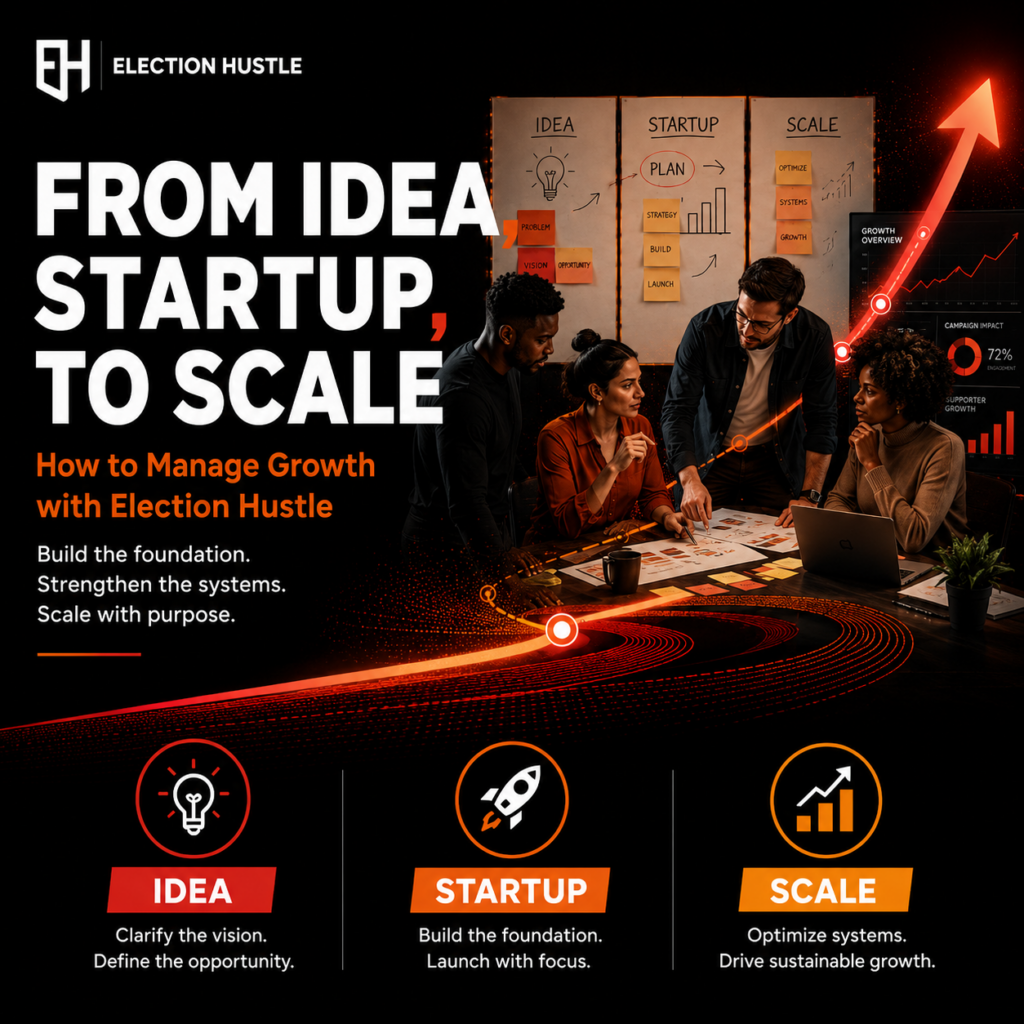
Idea Stage
Clarify the mission, audience, problem, and solution.
Startup Stage
Build the first website, social media presence, content calendar, business plan, and action pathways.
Traction Stage
Track engagement, listen to the audience, perform market research, and identify revenue opportunities.
Revenue Stage
Build donation systems, e-commerce, sponsorships, services, or products.
Team Stage
Define roles, recruit help, build remote workflows, and document expectations.
Systems Stage
Create repeatable workflows, task boards, access logs, backups, and reporting dashboards.
Pitch Stage
Create decks and materials for donors, sponsors, partners, clients, or funders.
Scale Stage
Repeat what works, improve what does not, protect the mission, and expand capacity.
This roadmap helps organizations grow in order.
Growth becomes easier when the next step is clear.
A 90-Day Growth Sprint
Election Hustle can think about growth in 90-day sprints.
First 30 Days: Clarify and Organize
Write the mission. Identify the audience. Define the offer. Create a basic business plan. Organize digital accounts. Build or update the website. Set one primary growth goal.
Days 31–60: Build and Test
Launch one campaign, one product, one sponsor offer, or one service package. Track audience response. Collect feedback. Test messaging. Build a simple email list or lead capture process.
Days 61–90: Measure and Scale Carefully
Review results. Improve the offer. Follow up with leads. Create a pitch deck or sponsor packet. Document the workflow. Decide what to repeat, pause, or expand.
This sprint can be repeated each quarter.
Small disciplined cycles create sustainable growth.
Conclusion: Growth Needs a System
Every organization wants momentum. But momentum without structure can become a burden.
An idea needs clarity.
A startup needs tools.
Early traction needs follow-up.
Revenue needs a model.
A team needs roles.
Operations need systems.
Digital growth needs security.
Support needs a pitch.
Scale needs discipline.
Chicago Southland Activities and Leaders shows how a community platform can grow from local engagement into a sustainable resource for activities, leaders, businesses, sponsors, and families.
3WF – Third Wave Feminism shows how a cause-based digital community can grow from awareness and advocacy into fundraising, merchandise, education, donor support, and staff sustainability.
Election Hustle brings these lessons together.
We help organizations move from idea to action, from startup to systems, from social media engagement to revenue, and from scattered momentum to sustainable impact.
Growth is not only about doing more.
It is about building better.
It is about protecting the mission while expanding the reach.
It is about turning community attention into organized infrastructure.
It is about helping people make a living while doing meaningful work.
It is about creating systems strong enough to carry the cause forward.
That is the Election Hustle way.
From idea, to startup, to scale — we help the work grow with purpose.